Citation is an integral part of scientific research and publications. It plays an important role in the dissemination of knowledge, the development of new ideas, and the formation of modern theories. In a world where the scientific community is constantly growing, researchers are faced with a pressing question: how to increase the visibility of their work and achieve active citation?
High citation rates of scientific works have a significant impact on a researcher's professional growth. They increase their recognition in the scientific community, facilitate the establishment of professional contacts, and open access to grants and programmes supporting scientific activity.
The role of citations in scientific works
Citations perform a number of important functions, including:
- Recognition of ideas and scientific conclusions.
- Providing readers with the opportunity to familiarise themselves with the original sources.
- Strengthening confidence in the results obtained by backing them up with verified data.
These are just three reasons that determine the importance of citation.
Why is it necessary to increase the citation rate?
Improving the citation rate of scientific articles is important for both scientists and scientific institutions. It contributes to:
- Increasing the visibility of scientific works and attracting the attention of colleagues, specialists and potential partners.
- Strengthening the scientific authority of the researcher and recognising their contribution to the relevant field.
- Improving positions in scientometric databases and rankings at the national and international levels.
- Obtaining new opportunities to participate in competitions, grant programmes and other forms of research funding.
In addition, the number of citations directly affects important scientometric indicators, in particular the Hirsch index, which is often taken into account when evaluating scientific activity.
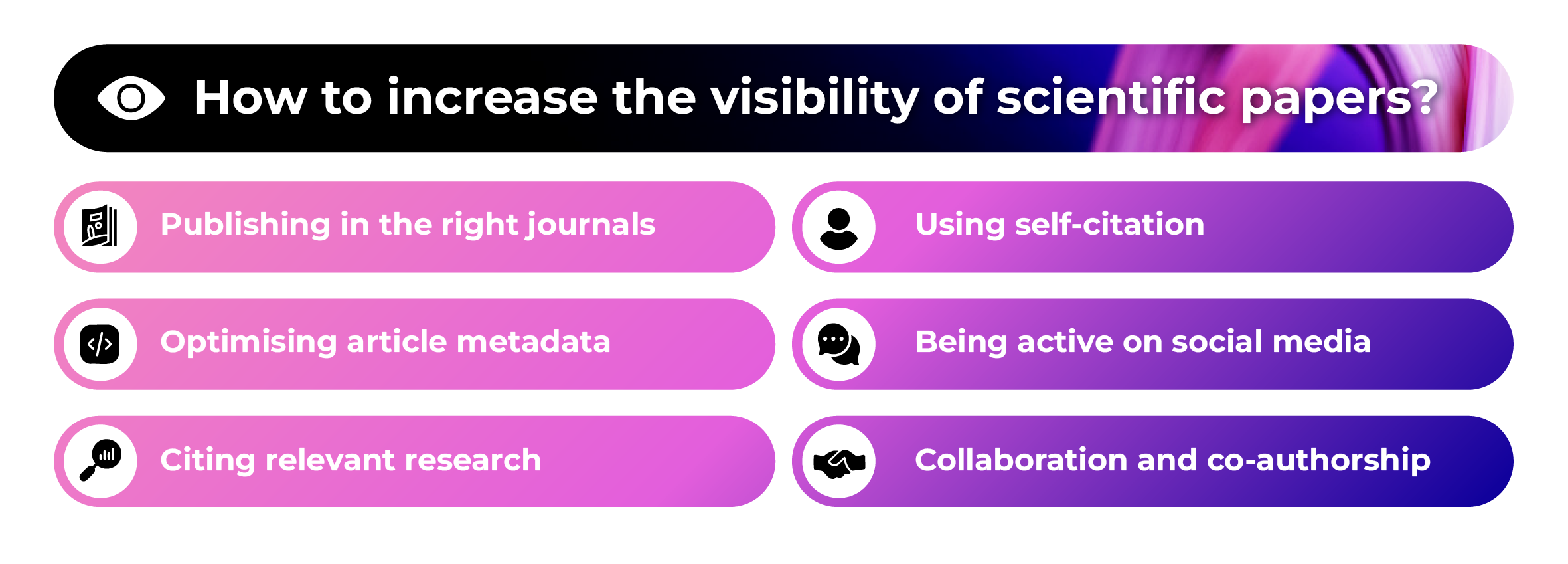
Publishing in the right scientific journals
Choosing the right scientific publication for publication is a strategic step in research. It not only ensures greater visibility and accessibility of research results, but also significantly affects its scientific value and the authority of the researcher.
The main criteria for choosing a journal:
- Relevance of the subject matter. The journal should correspond to the topic of your research. Publishing in a specialised publication increases the likelihood that the article will be read by the target audience – researchers working in the same or related fields. This increases the chances of being cited. Usually, the journal's focus and subject matter are described on its official website.
- Indexing in scientometric databases. Indexing of a journal in databases such as Scopus and Web of Science indicates its quality and recognition. Publication in such a publication increases the visibility of your work, strengthens your scientific authority, and contributes to an increase in citation rates.
- Type of access. Open Access significantly increases the chances of disseminating research results. Thanks to free access to articles, they can be read, used and cited by scientists from all over the world without restrictions. This promotes openness in scientific activity, accelerates the circulation of knowledge and allows authors to track the impact of their work.
Self-citation of scientific works
Self-citation is the process by which an author refers to their own previous publications. This indicator is usually expressed as a percentage and reflects the proportion of references to one's own works among all citations in a scientific work. It can also be one of the methods for increasing the overall citation rate. Self-citation plays an important role in shaping the scientific image of a researcher, influencing the assessment of their professional achievements and scientometric indicators. In general, it is not considered a violation of academic integrity, but it is important to maintain a reasonable balance and not abuse this method.
What percentage of self-citation in scientific works is acceptable?
Different sources provide conflicting information regarding the acceptable level of self-citation. Some indicate that the acceptable rate is up to 25%, while others cite limits ranging from 20% to 35%. At the same time, based on our many years of experience working with scientific journals indexed in the Scopus and Web of Science databases, we recommend not exceeding a self-citation rate of 12%. This level is considered safe for passing peer review, facilitates publication indexing, and avoids suspicion of excessive self-promotion, which is negatively perceived by the scientific community.
Optimisation of article metadata
Metadata is a key element of a scientific publication, as it significantly influences its visibility and subsequent citation rate. In the modern scientific environment, metadata also serves as a kind of marketing tool: among the large number of articles in abstract databases, researchers usually choose those with meaningful and clearly formulated metadata.
What is the metadata of a scientific article?
- Title
- Abstract
- Keywords
Properly formulated metadata increases the chances that the article will be found by other researchers, which, in turn, contributes to its citation. As a rule, a scientific publication is considered relevant for three to five years, and it is during this period that it has the greatest potential for dissemination in the scientific community — provided that the metadata is of high quality.
How to write metadata for a scientific article correctly?
- Title of the scientific article. First of all, attention should be paid to the title of the article. It should be clear, informative, not too short and not too long. The optimal length is up to 10-15 words. The title should accurately reflect the content of the research, avoid general formulations and contain key concepts related to the topic.
- Abstract. The abstract is the first information that the reader encounters, so it should be clearly structured and contain a brief description of the research objectives, methods used, main results, relevance of the work and recommendations. It is important that this structural element does not contain references to other authors. Its length should be between 150 and 300 words. At the same time, it is recommended to use keywords in the text of the abstract to ensure better indexing in databases and search engines.
- Keywords. Keywords also play an important role in the dissemination of scientific articles. They should reflect the main topic of the study and include key terms, concepts and directions. Keywords should not duplicate the title of the article, but should be logically related to it. The optimal number is 4 to 7 words or phrases. Well-chosen keywords will help improve scientometric indicators and better reach the target audience.
Activity on social media
Activity on social media significantly affects the recognition of a scientist and the popularity of their scientific publications. By avoiding the promotion of one's own research, one may lose the opportunity to attract the attention of a wider audience, including colleagues, journal editors, and potential partners. Today, more and more scientists are using platforms such as LinkedIn, Twitter, and Facebook to disseminate their work. Twitter is particularly active, especially among foreign scientific journals, which regularly publish information about new articles. This can serve as an example of effective communication in the scientific community.
It is also worth paying attention to ResearchGate, an international scientific platform that brings together researchers from around the world. Here you can share your publications, receive comments from colleagues, join discussions and establish professional connections. Active participation in ResearchGate contributes to a wider audience, increases the visibility of your work and, as a result, increases the number of citations.
Citing relevant research
Citing relevant research is one of the key tools for increasing scientific visibility. By referring to contemporary, influential sources, the author demonstrates awareness of the latest trends in their field, which increases the scientific community's trust in their research.
Citations also help establish connections with leading scientists whose works have been cited. This can increase the likelihood that they will read the new publication and, if necessary, cite it in their future works. Thus, a well-thought-out citation strategy and system is an effective tool for building authority and increasing visibility as a scholar.
Collaboration and co-authorship
Collaboration and co-authorship significantly increase a researcher's scientific recognition and popularise their research. This is primarily due to the fact that each co-author disseminates the results of their joint work in their professional environment, among colleagues, in institutions and through scientific platforms.
Co-authored articles are usually of higher scientific value and have a wider impact, which contributes to an increase in the number of citations. This, in turn, has a positive effect on the researcher's citation indices and visibility. Joint scientific work with colleagues, especially foreign ones, or with scientists from leading scientific institutions and universities, contributes to increasing the influence, authority and visibility of the scientist in the international scientific community.
Thus, active participation in joint research not only contributes to the development of science, but also shapes the scientist's reputation, expands their network of contacts and increases their chances of recognition in the global scientific community.
Do you want to increase citations and make your scientific works more visible? Contact Scientific Publications! Thanks to our many years of experience, we guarantee not only high quality but also complete transparency of our services. Get a free consultation from a manager by filling out the form below. Together to new achievements!