An editor's first acquaintance with a piece of research does not happen through the article itself, but through the cover letter accompanying it. It is, so to speak, the article's business card, which determines whether the manuscript will even be sent for peer review at all. Authors often spend months on their research but pay practically no attention to preparing the cover letter. This frequently becomes the reason for rejection even before anyone has assessed the scientific value of the work itself. How can this be avoided? How can you tell that your cover letter is weak?

What a cover letter is and why it is needed
A cover letter – is a special document submitted alongside the article to the journal's editorial office. In it, the author must explain the subject of the research and argue its relevance and its fit with the particular publication's scope.
Formally, the letter is not part of the scientific work and does not affect its content. But in practice, it is precisely this letter that forms the first impression of the author – in particular, how carefully they have approached the journal's requirements, whether they understand its readership, and whether the research genuinely fits there. Editors receive dozens of submissions every day, and the letter is what they use to quickly filter out irrelevant work even before passing it on to reviewers.
How to understand that your cover letter is weak?
You should not expect that a letter written in twenty minutes will automatically open the way to the next stage – peer review. Despite its seemingly simple format, this document has clear requirements regarding both content and presentation, and mistakes in it can cost the article a rejection before anyone has even read it. What exactly leads to this?
A unified text for different journals
A letter sent to several editorial offices at once is easy to recognise, since it does not explain why the article suits that particular journal and does not take into account its thematic specifics. Editors pay attention to this first of all, since fit with the publication's profile is precisely one of the key factors influencing the decision on whether to consider or reject a manuscript without peer review.
Accordingly, although adapting the letter for each journal takes more time, it substantially increases the chances of a positive response.
Template phrases instead of facts
Formulations such as "a unique discovery" or "an innovative approach" do not prove the significance of your research – on the contrary, they only add subjectivity to the text and may arouse scepticism in the editor. Instead of evaluative words, it is worth citing a specific result: for example, what problem has been solved, what data have been obtained, and what practical application the work has.
Absence of confirmation of originality
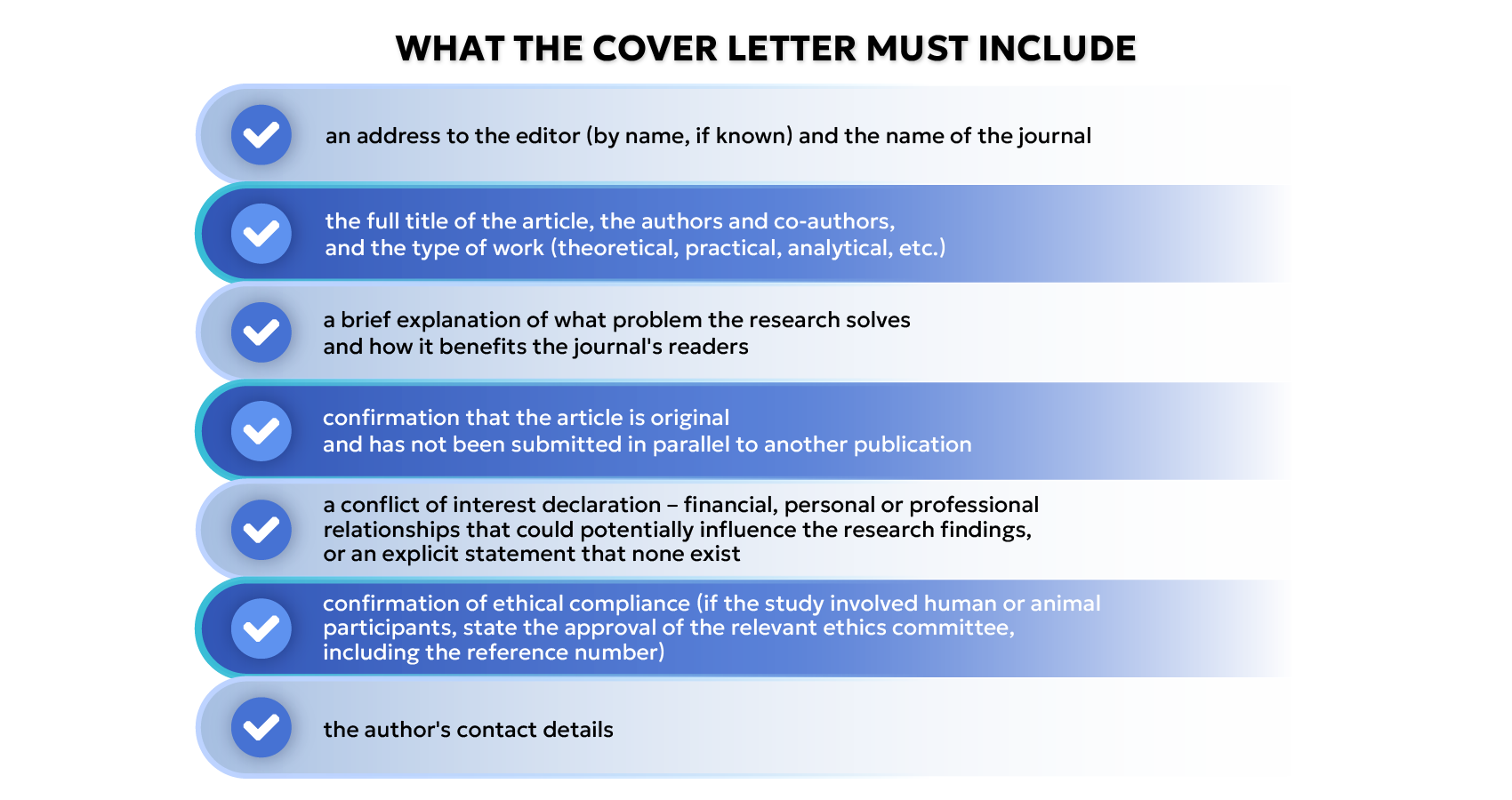
If the letter contains no direct statement that the article has not been published before and has not been submitted simultaneously to another journal, the editorial office may reject it even before checking the content, owing to the risk of conflict with the publication's policy on duplicate submissions. This is one of the points that editors check almost automatically, so it cannot be skipped.
Ignoring the journal's requirements
Most publications publish their own instructions for authors, including regarding the structure of the cover letter, its length, and even its formatting. If the journal explicitly requires certain elements (for example, a conflict-of-interest declaration, suggested reviewers, or specific formatting) and the letter does not contain them, the editorial office may reject the submission automatically, even before assessing the scientific quality of the work.
Therefore, before writing the letter, it is worth checking the "Guide for Authors" page on the journal's website in order to avoid negative consequences.
Excessive length
Even if you wish to describe your achievements in great detail, you must not overdo the length of the text. A letter longer than one A4 page is unlikely to be read in full, since this requires a considerable amount of time. It is important to remember that editors review dozens of submissions a day and value brevity. Therefore, anything that can be said in three sentences should not be stretched out into a paragraph.
The cover letter plays one of the decisive roles in submitting an article to a journal. A clear, concise, and informative presentation of the key aspects of the research substantially increases the chances that the manuscript will reach the review stage. However, these chances depend not only on the content, but also on how well the letter is personalised for the specific journal and its requirements.
If you are planning to publish in an international journal and need professional support, get in touch with the company Scientific Publications company. Our specialists will audit your article, select a relevant journal, and support you at every stage of the publication process. Would you like to find out more? Fill in the form below, and our manager will provide you with a free consultation. Together towards new scientific achievements!