The Hirsch index is one of the most common indicators for assessing a researcher's scientific productivity and influence. This metric helps to evaluate a scientist's contribution to the scientific field, taking into account both the number of their publications and their citation rate. In this article, we will take a detailed look at what the Hirsch index is, how to calculate it, and its significance for a scientist's career.
What is the Hirsch index?
The Hirsch index is a numerical indicator that reflects the balance between the number of a researcher's scientific publications and their citation rate. In simple terms, the h-index shows how often a scientist's work is cited by other scientists.
How does it work? For example, if a scientist has an h-index of 7, it means that they have 7 publications, each of which has been cited at least 7 times.
The main advantage of this indicator is that it avoids distortions, such as when only the number of publications (which may be large but have little impact) or the total number of citations (which may depend on a few very popular works) are taken into account.
It allows us to understand how consistently a scientist publishes relevant, influential research that is of interest to other scientists, and also:
- does not overestimate a single ‘successful’ study with a large number of citations
- does not overestimate the rating of a scientist with many insignificant publications
- reduces the impact of random surges in popularity
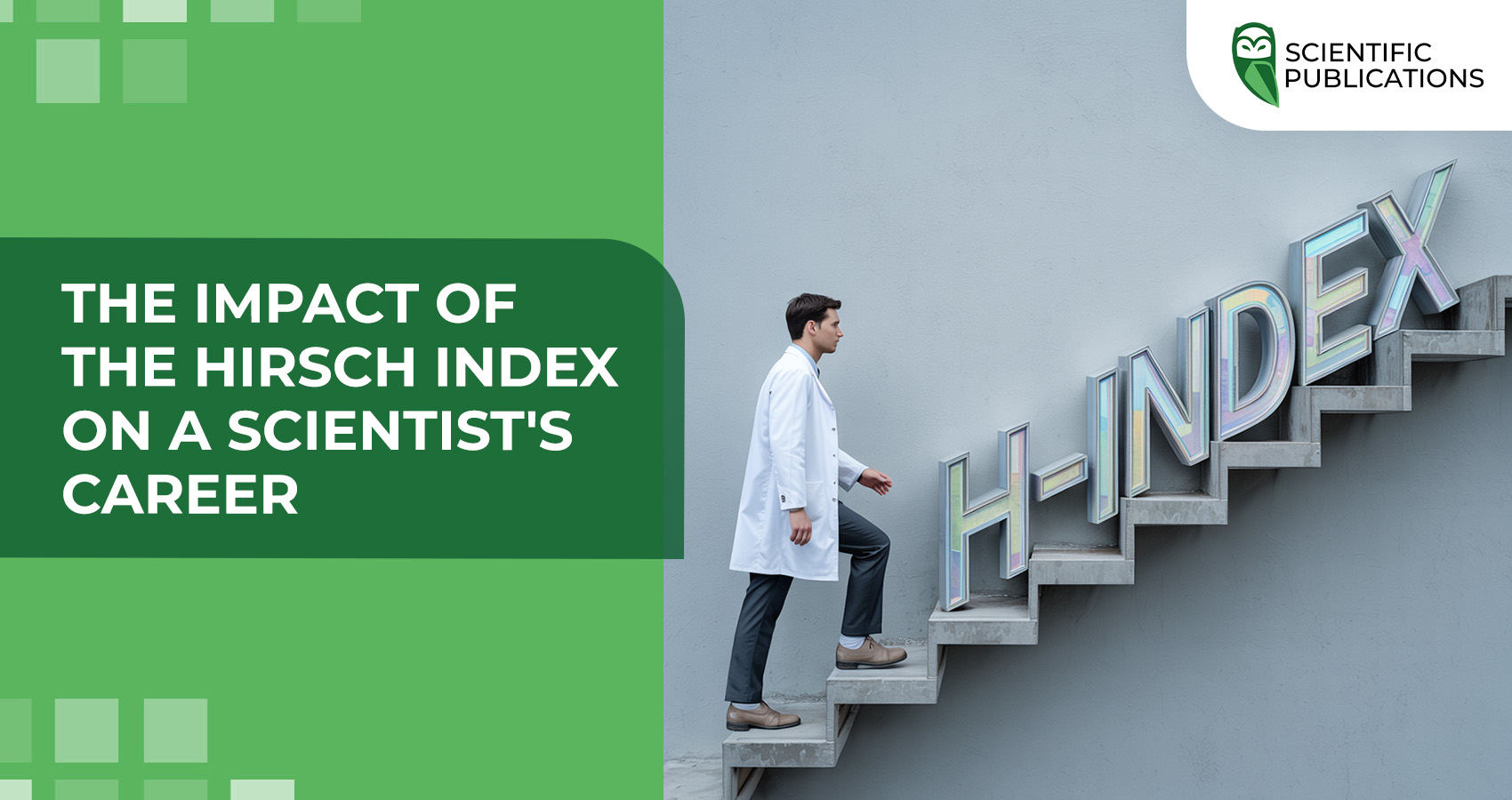
How does the Hirsch index affect a scientist's career?
The role of the Hirsch index cannot be overestimated, as this indicator performs a number of functions that help scientists advance in the scientific community and grow professionally. In particular, it covers a number of aspects, which we will discuss in more detail below.
1. Professional recognition
A high Hirsch index indicates that a scientist's research is respected among their colleagues. This means that their work is not only published but also actively cited, confirming its contribution to the development of science and its impact on the relevant field of knowledge.
In addition, a high index can also serve as an indicator of stable and long-term scientific activity, which contributes to enhancing the scientist's reputation at the international level. This, in turn, strengthens their scientific reputation and opens up new opportunities for collaboration.
2. Career growth
When it comes to appointments to senior positions at universities, obtaining academic titles or participating in national competitions, the h-index is often one of the key criteria for selecting candidates.
For example, if the university management has difficulty choosing a candidate for a specific position, the Hirsch index is a decisive factor in the decision-making process. Accordingly, preference will be given to the scientist with the higher index.
3. Access to funding and grants
Granting institutions (both national and international) use the h-index as an indicator of the scientific productivity of applicants. In this case, the situation is similar to appointments to academic positions. When the choice is between two candidates, the scientist with the higher Hirsch index has a better chance of receiving a grant.
4. Ability to influence the development of science
Researchers with a high h-index are often invited to become reviewers, members of editorial boards of journals, and speakers at conferences. They are also more often involved in the development of educational programmes, scientific standards and recommendations that shape the future of the field.
In addition, a high Hirsch index opens up opportunities for collaboration with other scientists to implement large-scale scientific projects. This opens up broader opportunities to influence the formation of future scientific directions.
Is it possible to increase the Hirsch index?
Since the Hirsch index directly affects a scientist's career, many researchers strive to increase it. There are many strategies for improving this indicator, the most effective of which include:
- publishing in international peer-reviewed journals that are indexed in Scopus or Web of Science
- choosing relevant topics that are in demand in your scientific field. This will increase the chances of your article being cited
- collaborate with other scientists, as this will allow you to share your audience with other co-authors
- optimise the metadata of your article
- publish in open access journals
To learn more about other strategies for improving your Hirsch index, read our article on this topic.
The Hirsch index is an important tool for evaluating the scientific activity of researchers. It not only helps to assess a scientist's contribution to the development of science, but also contributes to their career growth, attracting funding and building a reputation in the academic community.
If you are having difficulty improving your Hirsch index contact Scientific Publications. Our specialists will analyse your profile and prepare an individual plan to improve your index. To learn more about our service and receive a free consultation, fill out the form below, and our manager will contact you shortly. Together to new scientific achievements!