The process of defending a dissertation often causes stress for many researchers, as the outcome determines whether they will successfully obtain the desired academic degree. To structure the presentation properly and cover all key aspects of the research, candidates use an accompanying dissertation presentation. How should it be prepared correctly? This article will guide you through the process.
Dissertation defence presentation: what is its purpose?
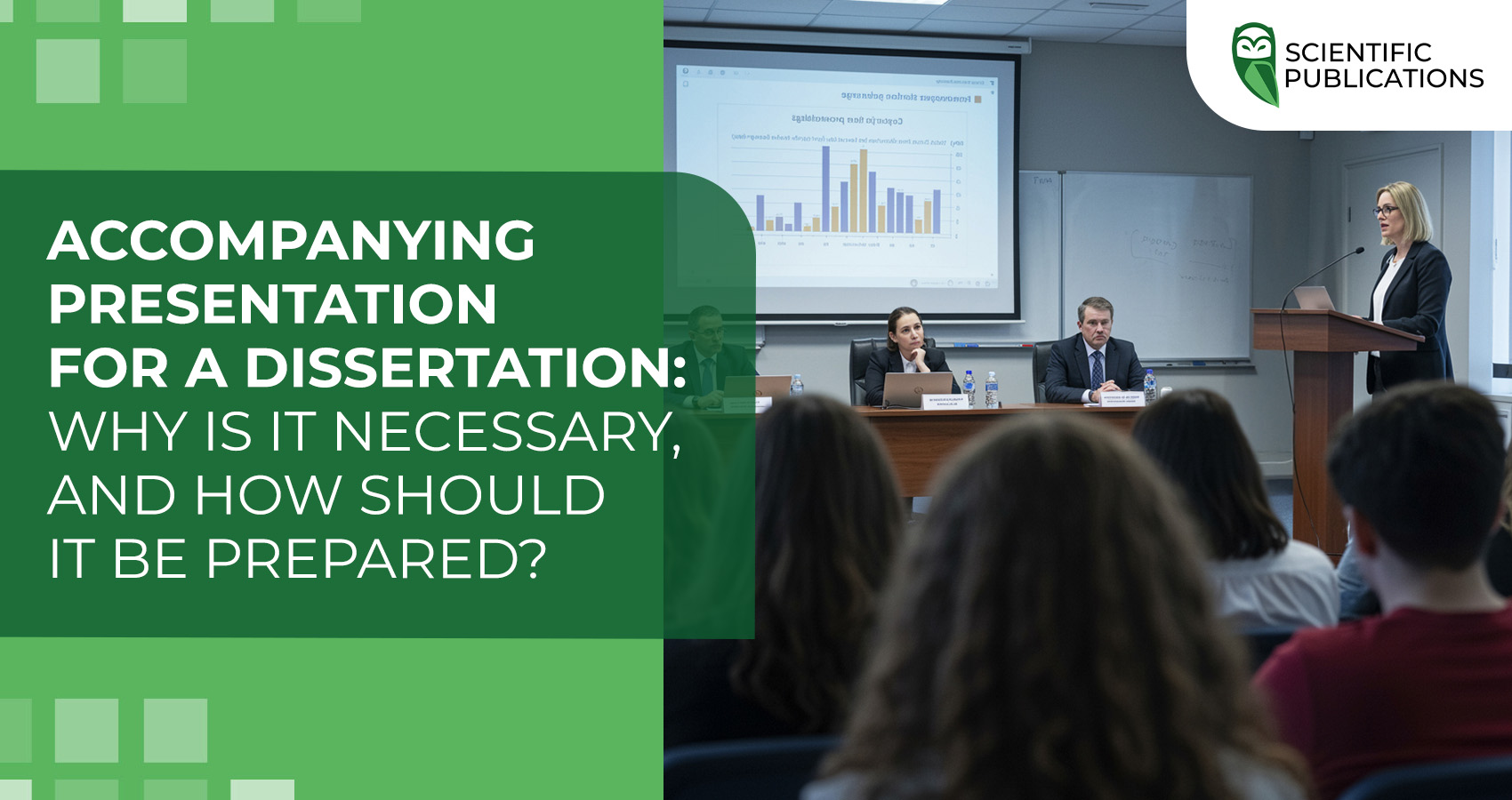
An accompanying presentation – is a structured visual material used by the degree candidate during the public defence of the dissertation. It represents a systematic summary of the key points of the work, presented as a sequence of slides that help the dissertation committee better understand the content, logic, and main findings of the research.
However, to ensure that the presentation complements your speech rather than making it harder for the audience to follow, it is crucial to follow certain rules regarding its structure and design. Let’s review them in more detail.
Step 1. Set time limits and define the scope of the material
Typically, the allotted time for a dissertation defence is 15–20 minutes. Since time is limited, it must be distributed rationally to cover all key aspects of the research.
To ensure sufficient attention to each point, do not include too many slides. It is best to aim for 12–18 slides in total, dedicating about 60–90 seconds per slide and leaving 2–3 minutes for questions. To check if you fit within the time frame, rehearse your speech with a timer and adjust the content by removing secondary details.
Step 2. Build a logical structure for the presentation
Sometimes, when creating a presentation, researchers add secondary information to the slides that could be omitted. To avoid this, focus on several key components of the dissertation:
- Introduction (1 slide) – problem statement, aim, and scientific novelty.
- Methodology (1–2 slides) – research sample, data collection and analysis methods.
- Results (2–3 slides) – key empirical findings with a minimal amount of illustrative material.
- Conclusions (1 slide) – interpretation of results, practical recommendations, and directions for future research.
After the title slide, include a table of contents slide with numbered sections. This will help the committee navigate the structure of your presentation.
Step 3. Choose a restrained template
Use a single template with a neutral colour scheme. This aspect is essential, as overly bright or clashing colours can distract and make the material harder to perceive.
For example, select 2–3 colours: dark blue for headings, black for text, and a white background. Pay attention to typography – in formal presentations, fonts such as Arial or Calibri are most commonly used. The optimal font size is 24 pt for body text and 32–36 pt for headings. Avoid animations, decorative elements, or excessive use of colours, as they can distract the audience’s attention.
Step 4. Follow the principle of brevity when filling slides
Remember that the presentation should complement your speech, not duplicate it word for word. If you are unsure whether your slides contain too much text, apply the “6×6 rule”: no more than six lines of text and six words per line. Whenever possible, replace long sentences with tables, charts, or diagrams – this will help visualise your data more effectively.
Step 5. Ensure high-quality visualisation of data
As mentioned in the previous section, visualisation enhances the perception of information, but only if all graphic elements are of high quality. All images should have a resolution of at least 300 DPI and display clearly when projected.
If you use graphs, remember to label the axes and indicate units of measurement.
At first glance, an accompanying dissertation presentation may seem like a mere formality rather than a necessary part of the defence. However, it is an effective tool that can significantly improve your performance and help you present information in a structured way.
If you are struggling with writing your dissertation, contact Scientific Publications. Our experts will help refine your research based on your materials and prepare it according to university requirements. Would you like to learn more about our service? Fill out the form below, and our manager will provide you with a free consultation. Together to the new scientific achievements!