The BULGARIA 2030 programme is currently being implemented in Bulgaria, the aim of which is the development of the country in various directions. In an exclusive article for the author's column, Vladislav Romanenko, Director of the Scientific Publications company, spoke in detail about the goals that Bulgarian science sets for itself within the framework of this strategic document, the mechanisms envisaged for their achievement, and the challenges that the scientific community may face.
In addition to the requirements of universities, the presence of publications in international journals in Bulgaria is also regulated at the state level, namely within the framework of the BULGARIA 2030 development programme, which can be found on the website of the Ministry of Finance.
We have previously mentioned how the country is integrating scientists into the international scientific space. This time, we would like to focus specifically on the matter of publications in international journals within the framework of compliance with the development strategy.
Within the given programme, we are interested in point P2: Science and Scientific Infrastructure, where the goal of this priority is the development of high-quality and effective research.
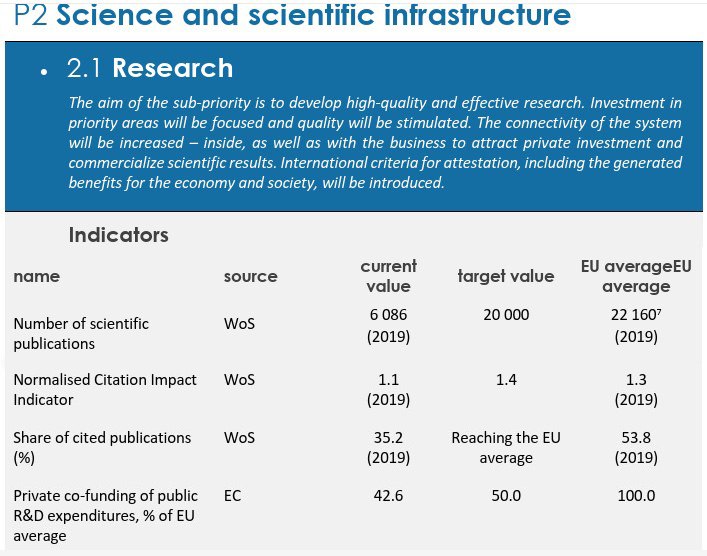
As can be seen from the data indicated, it is important not only to increase the overall number of publications in the Web of Science database (from 6 thousand according to 2019 data to 20 thousand by 2030), but also to improve the quality of journals (impact factor). At least half of publications must also be cited in other journals. This means that published articles must possess a high degree of relevance in order to attract the interest of other scientists. Increasing the amount of private funding for scientific publications has also been highlighted as a separate point.
In order to understand the dynamics of publications in international databases, one can turn to Scopus analytics, as the majority of Bulgarian scientists publish their work in journals indexed by this database.
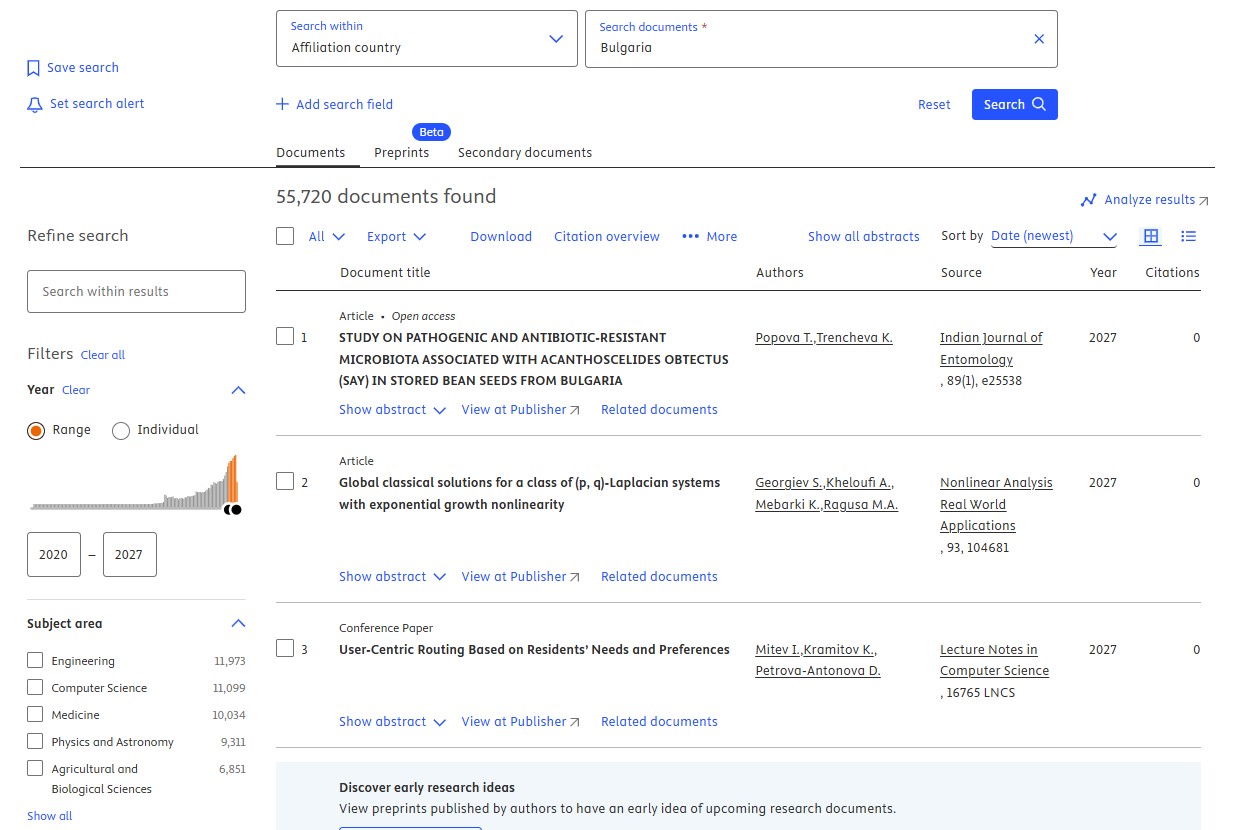
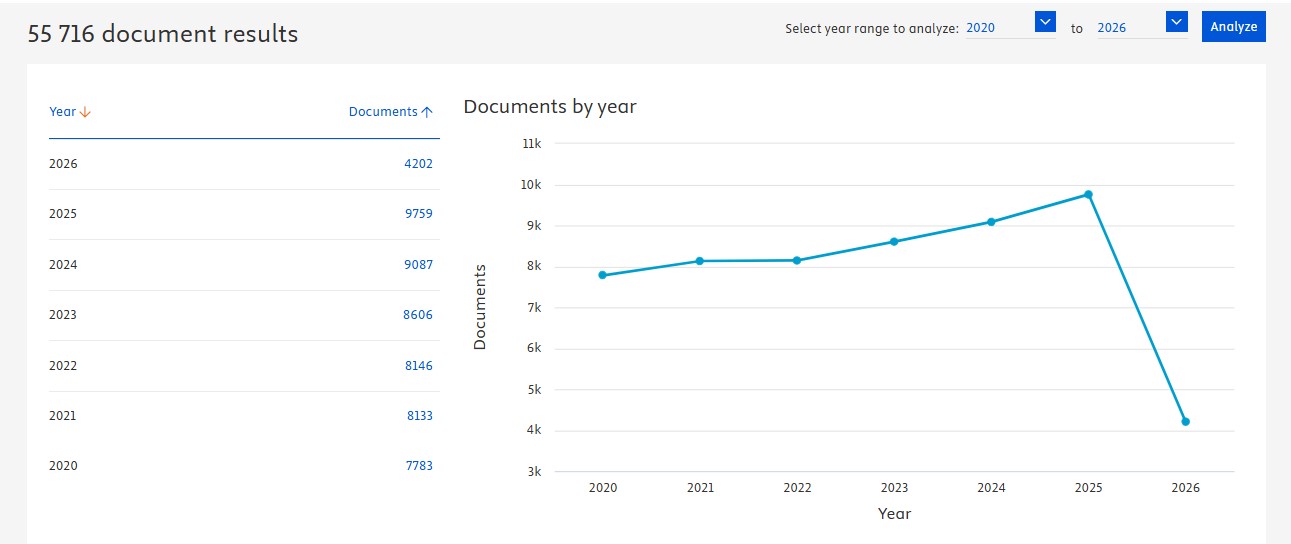
Over the period since 2020, more than 55 thousand publications have already been indexed in the Scopus database, which is a fairly significant figure.
Analysing publication activity by year, we can see that the number of publications is gradually increasing every year, confirming a positive trend and the fact that Bulgarian scientists are increasingly publishing the results of their research specifically in prestigious international journals.
The publication figure for 2026, at around 4 thousand, is explained by the fact that the indexing of the spring issues of journals with published articles is currently under way, while the main peak of authors' publication activity occurs in autumn and winter. Consequently, the overall publication activity figure for 2026 will only become available in the first quarter of next year. Judging by the current dynamics of publications, it should exceed the 10-thousand mark.
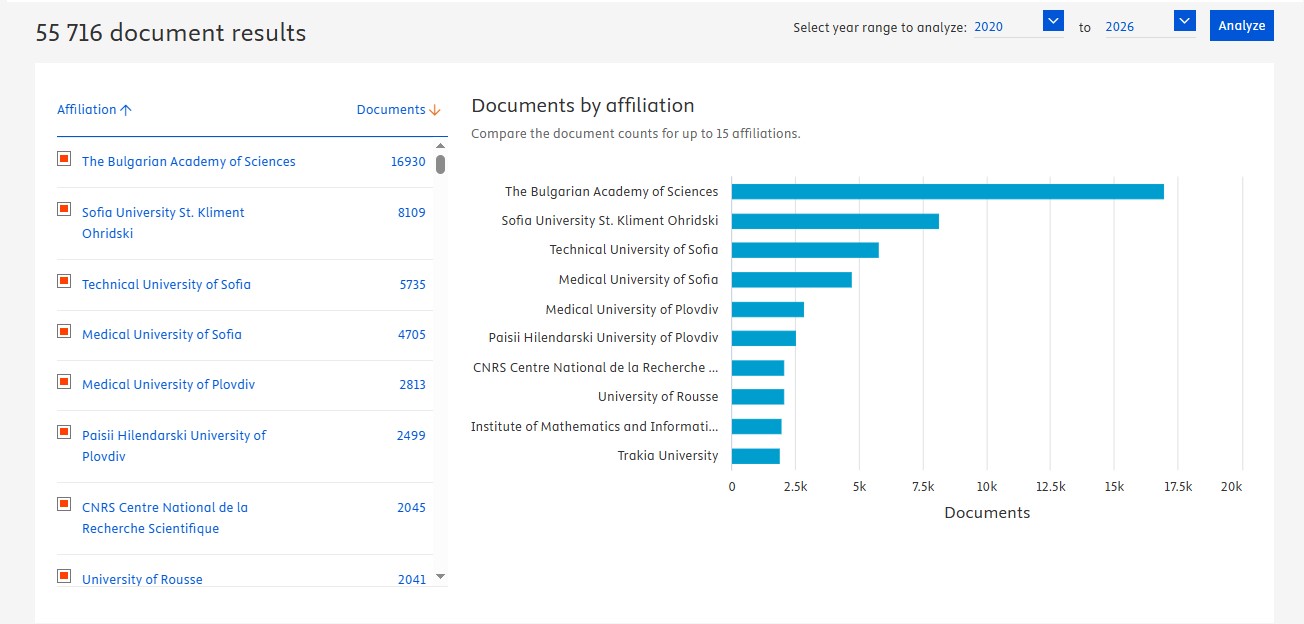
More than a third of scientific articles are published by the Bulgarian Academy of Sciences, which further confirms its status as the country's leading scientific institution. Next in the ranking come Sofia University St. Kliment Ohridski (more than 8 thousand publications) and the Technical University of Sofia (almost 6 thousand publications).
The fields of science in which articles are published should also be considered separately, so that in future the most priority sectors for the allocation of funding and grant support can be determined.
Engineering and computer science occupy the top positions. Their leading positions are explained by the fact that these fields are developing actively, which in turn encourages scientists to publish the results of their discoveries, while the large number of journals indexed by Scopus specifically in technical sciences significantly simplifies the publication process.
The number of articles in medicine and agricultural sciences is considerably lower, but still falls within the top 5 sectors in Bulgaria according to Scopus data.
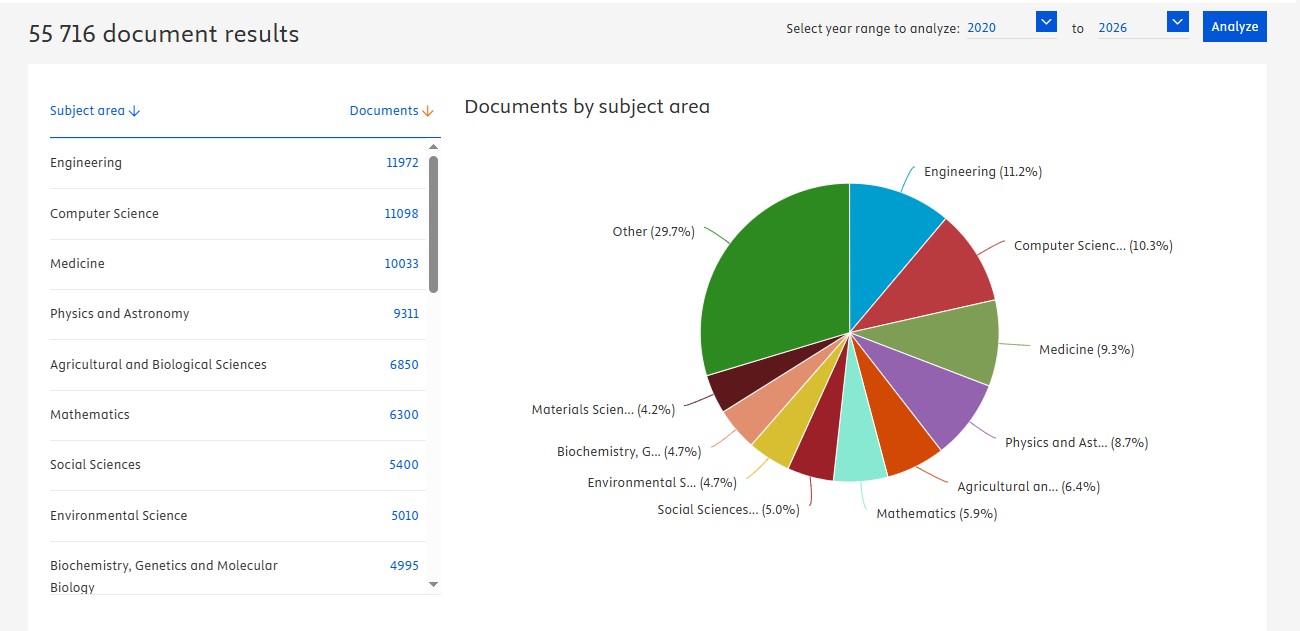
Separately, it is worth highlighting the field of social sciences, which accounts for only 5% of all published articles. Given the number of humanities institutions, this figure could be significantly better. However, there are a number of challenges that need to be overcome in order to increase the number of such publications and meet European standards.
By analysing the statistics of the Scopus database, one can see what challenges scientists face in their work (these results can also be extended to the WoS database, as the situation there is similar).
Difficulties in getting published in Scopus
An analysis of the statistics from the Scopus database reveals the challenges researchers face in their work (these findings can also be applied to the WoS database or in relation to the WoS database).
Among the main problems faced by Bulgarian scientists when publishing in Scopus and WoS, the following can be noted:
- The high cost of publication fees in top-ranked journals.
- A lengthy review period with no guarantee of a positive outcome (a journal may consider an article for around a year and still reject it for further publication).
- A lack of additional funding from the state, university, or private foundations.
As a result, it is easier and quicker for scientists to publish the results of their research in conference proceedings or university journals, which are less highly ranked and not always suitable for achieving the required goals (re-election to a position, defence of a dissertation, reporting on grant programmes, and others).
How to increase publication output in Bulgaria?
- Cooperation with other scientists in your field. Most journals allow for the publication of articles with co-authors, of whom there may be up to 5 people. This significantly reduces the financial burden of publication and allows the preparation of an article to be divided between scientists, which will further raise the status of the publication and the chances of acceptance by a prestigious journal.
- Monitoring international programmes supporting publication activity. Programmes run by the Bulgarian Academy of Sciences, the Ministry of Education, and other funds (the European Commission, the European Regional Development Fund, Horizon) can cover a large part of the cost of publication, which will make it possible to regularly publish the results of one's work in peer-reviewed journals.
- Participation in joint publications with scientists from other countries. This will make it possible, after publication and indexing in the database, to receive more citations for articles, as the material will be referenced by scientists from several countries.
- Presentations at prestigious conferences with the publication of results in proceedings that are indexed by the Scopus or Web of Science databases.
Scientific Publications company is ready to help you with publication in top-ranked Scopus or Web of Science journals. Our specialists will carry out a preliminary assessment of your material, help with the choice of journal, liaise with the editorial board, and provide support until the article is published in the journal and subsequently indexed in the database. Fill in the form below, and our manager will contact you shortly.