The Director of the Scientific Publications company, Vladislav Romanenko, prepared an article for the author’s column in which he explained how to assess the dynamics of a university’s ranking positions in the Bulgarian National H-index Ranking using Medical University of Plovdiv as an example.
As our regular readers are certainly aware, a national ranking based on the Hirsch index (Bulgarian National H-index Ranking) has been operating in Bulgaria for several years. This is an independent resource that ranks scientific organisations in the country according to their level of citation impact in international journals. Moreover, it allows one to view both the ranking list of organisations and individual researchers within a single institution. This, in turn, makes it possible to assess the degree of contribution of a particular researcher to the citation ranking of a university or institute.
One of the features of such a ranking is the ability to track the dynamics of growth or decline in citation indicators within universities, in order to identify future areas of development and analyse the contribution of individual researchers to the overall university citation ranking.
Since leading positions are usually occupied by the same institutions due to their high scientific output and citation impact, positions lower in the ranking may change over time.
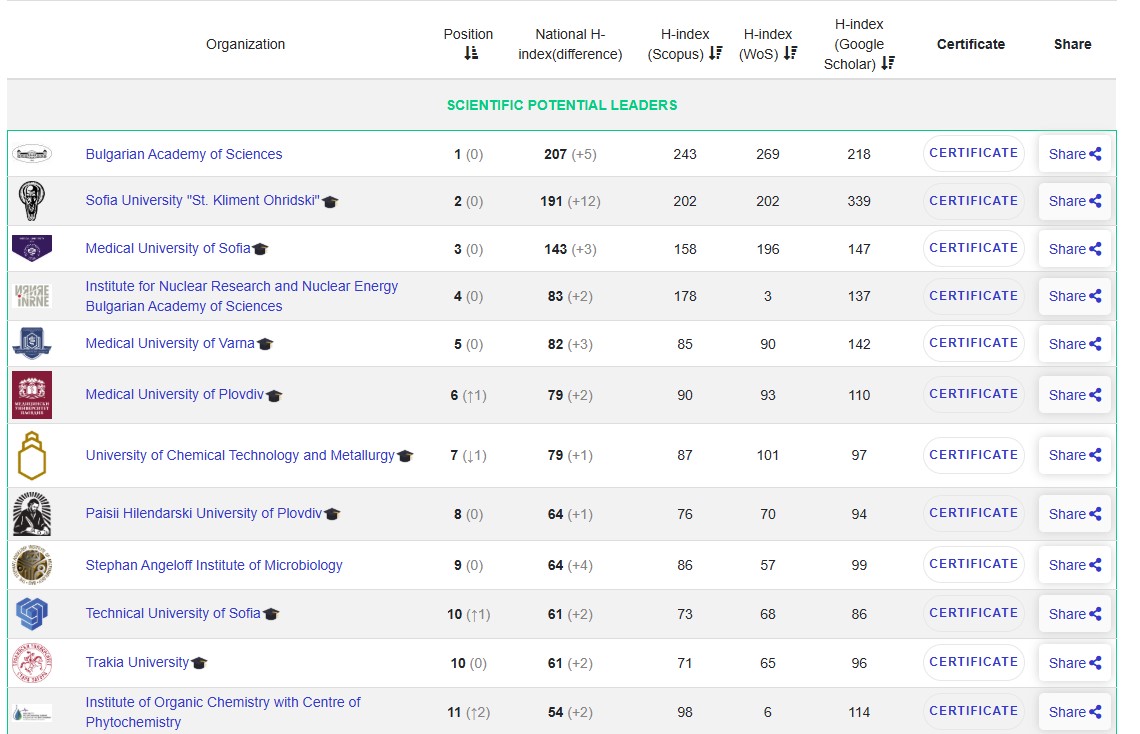
One of the clear examples is Medical University of Plovdiv, whose position dynamics I propose to examine in today’s review.
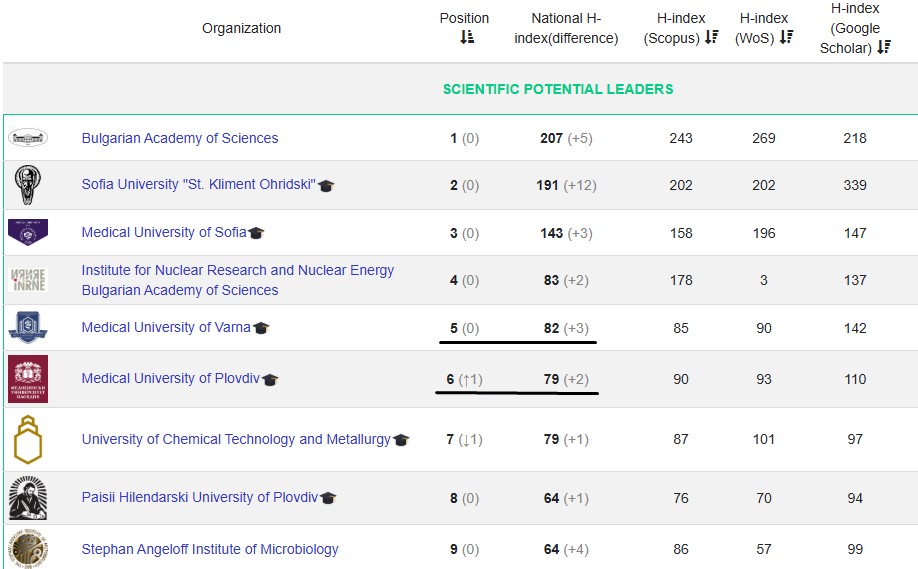
As can be seen from the overall ranking list of universities, as of summer 2026, the university is in 6th place and is marked in the ranking as “one of the leaders of scientific potential in the country”.
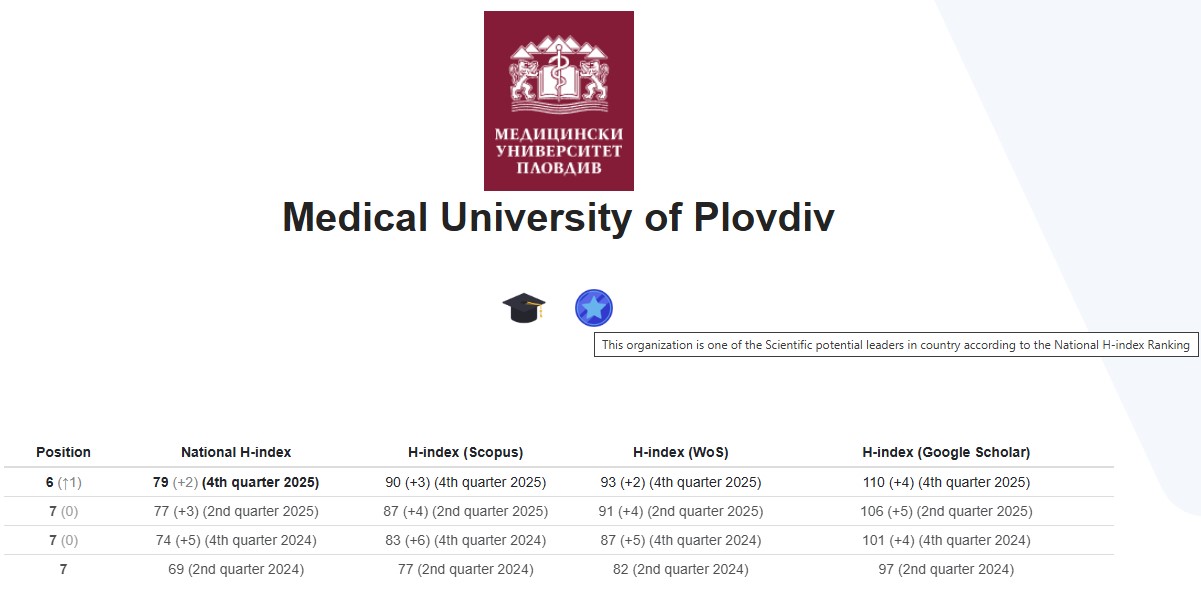
Since the national ranking has been tracking university positions since 2024, it is now possible to observe the dynamics of the institution’s citation growth.
At the beginning of 2024, the university held 7th place in the citation ranking, with coefficients of 77 in Scopus, 82 in Web of Science, and 97 in Google Scholar, as well as an overall coefficient of 69 in the national Hirsch index ranking.
Subsequently, throughout 2024–2025, these indicators grew organically and gradually, reaching values of 90, 93, and 110 in the databases, and an overall coefficient of 79. The increase of the institution’s overall Hirsch index by 10 points allowed it to rise to 6th place among the country’s universities and scientific organisations. This demonstrates that the works of the researchers are regularly cited, and the university is mentioned in the bibliographies of scientific papers, which also affects its prestige and ranking.
In addition to the Bulgarian National H-index Ranking, the university’s positions can also be analysed using the Scopus database, as it is always better to compare information from several authoritative sources in order to obtain an objective assessment and reliable information.
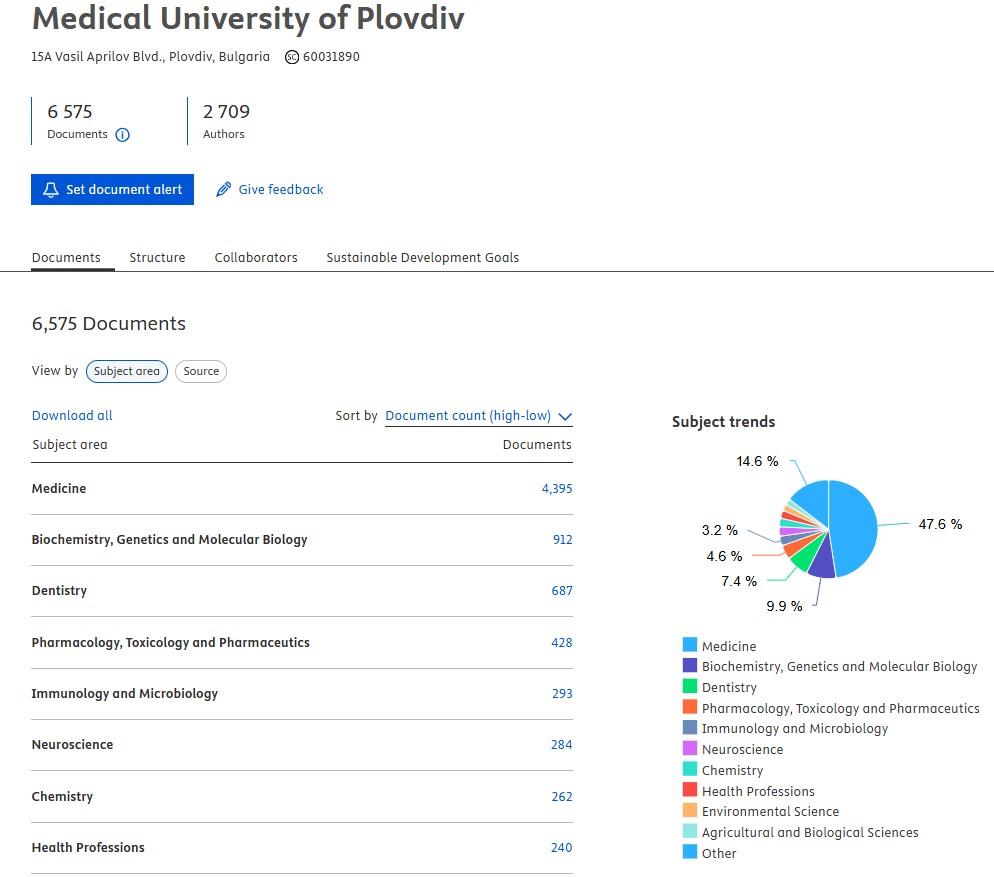
Based on Scopus data, the platform currently indexes 6,575 scientific works with authors from this university. At the same time, more than 60% of publications (namely 4,395) are indexed in the medical subject area database.
This indicator demonstrates that the articles are published in the relevant subject area and in prestigious journals, meaning they are more likely to be cited by other researchers, in particular doctoral candidates when preparing dissertations and monographs.
Another factor that significantly influences the citation level of publications is cooperation between universities, in particular international collaboration.
The importance of this factor should not be underestimated, as collaboration with researchers from other universities leads to your works being cited much more frequently. This occurs because the visibility of the article within the academic community is increased.
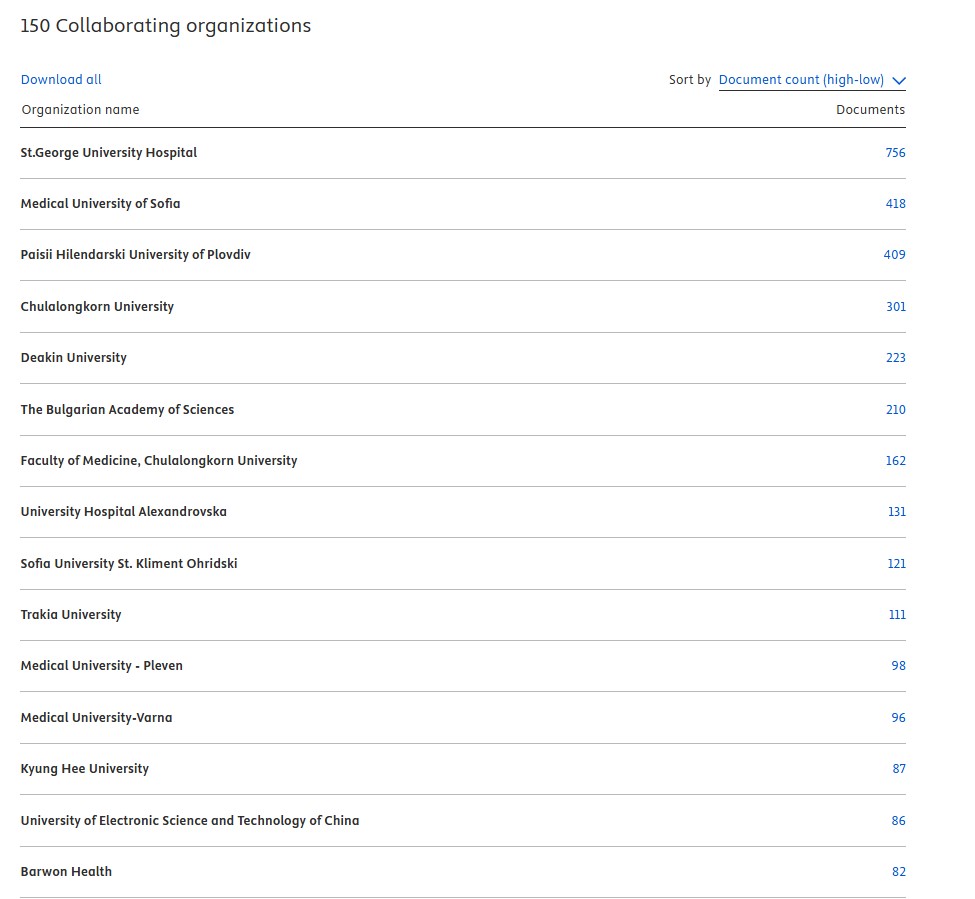
Medical University of Plovdiv also has no issues with cooperation with other institutions, as the university publishes in co-authorship with researchers from 150 different organisations, ranging from leading universities in the country and hospitals to universities in China, Thailand, Australia, Korea, and other countries around the world.
The combination of the above-mentioned factors determines positions in the national university ranking. Regular citation of researchers’ articles in prestigious journals, international cooperation and co-authorship with other researchers, as well as publication in high-ranking international journals, are the key to the success and scientific recognition of the university not only in the country but also worldwide.
In addition, if the university increases its overall citation indicator by 4 points this year, it may qualify for a position in the top 5 leading universities in the country. However, it should not be forgotten that such rankings are dynamic, and other universities are also actively cited. Whether Medical University of Plovdiv will achieve leading positions with the update of the 2026 ranking remains to be seen. I believe we will find out by the end of the year.
Would you like to contribute to your university’s ranking by increasing the citation impact of your own research outputs? Leave an application on our website, and the specialists of the Scientific Publications company will help you select the most optimal form of cooperation.