Plagiarism is one of the most widespread problems in the academic environment. Its consequences are linked not only to a decline in trust towards researchers who resort to this practice, but also to a slowdown in the development of science as a whole. In an exclusive article for the author's column, Vladyslav Romanenko, Director of the Scientific Publications company, explained what constitutes the uniqueness of scientific research and what role academic integrity plays in the development of science in Bulgaria.
In the modern academic environment, the number of published articles has increasingly come to be considered alongside questions of their quality, scientific value, and originality of research. Nowadays, a formally composed article placed in a scientific journal is no longer sufficient for publication. It must represent an independent scientific contribution, contain reliable results, and allow other researchers to understand what is unique and new that it adds to existing scientific knowledge.
This is precisely why the uniqueness of scientific material should be regarded not merely as a technical requirement when preparing a manuscript, but as one of the fundamental principles of academic integrity.
Recently, when scholars approach the company, questions increasingly arise concerning the high percentage of originality of material, as well as low indicators of the use of artificial intelligence in articles (this problem has emerged relatively recently, in connection with the rapid development of AI technologies).
The uniqueness of a text in the modern scientific world is not simply "a low percentage of similarity with previously published materials". When discussing the uniqueness of scientific publications, originality-checking systems (so-called anti-plagiarism systems) are often used, as they represent an important tool for identifying potential problems. However, scientific uniqueness cannot be reduced solely to a particular percentage displayed by software.
A scientific text is, by its very nature, based on already existing knowledge. Researchers must use concepts, theories, methods, definitions, and results developed by other authors. This is an entirely routine and appropriate part of the scientific process. It is important that such sources are correctly cited, and that the author's own scientific results are clearly distinguished from already published knowledge. This makes it possible to trace the author's genuine contribution, as well as to determine the basis on which the researcher arrived at particular conclusions.
Thus, genuine uniqueness of a scientific publication lies, above all, in an independent scientific contribution: new data, progressive methodology, a unique interpretation, a research model, a novel application of an existing method, or another result that expands scientific knowledge.
Why is uniqueness important for the quality of scientific results?
Scientific literature constitutes a particular system for the accumulation of knowledge. Each new work becomes part of this system and may subsequently be used as a basis for other research. If an article does not contain a sufficient independent contribution, it merely increases the number of publications without necessarily expanding the body of scientific knowledge.
It is precisely here that one of the most significant distinctions between the quantity of scientific publications and their quality lies. The scientific system does not develop solely through an increase in the number of articles. It is necessary for each subsequent piece of research to add value to the existing scientific base.
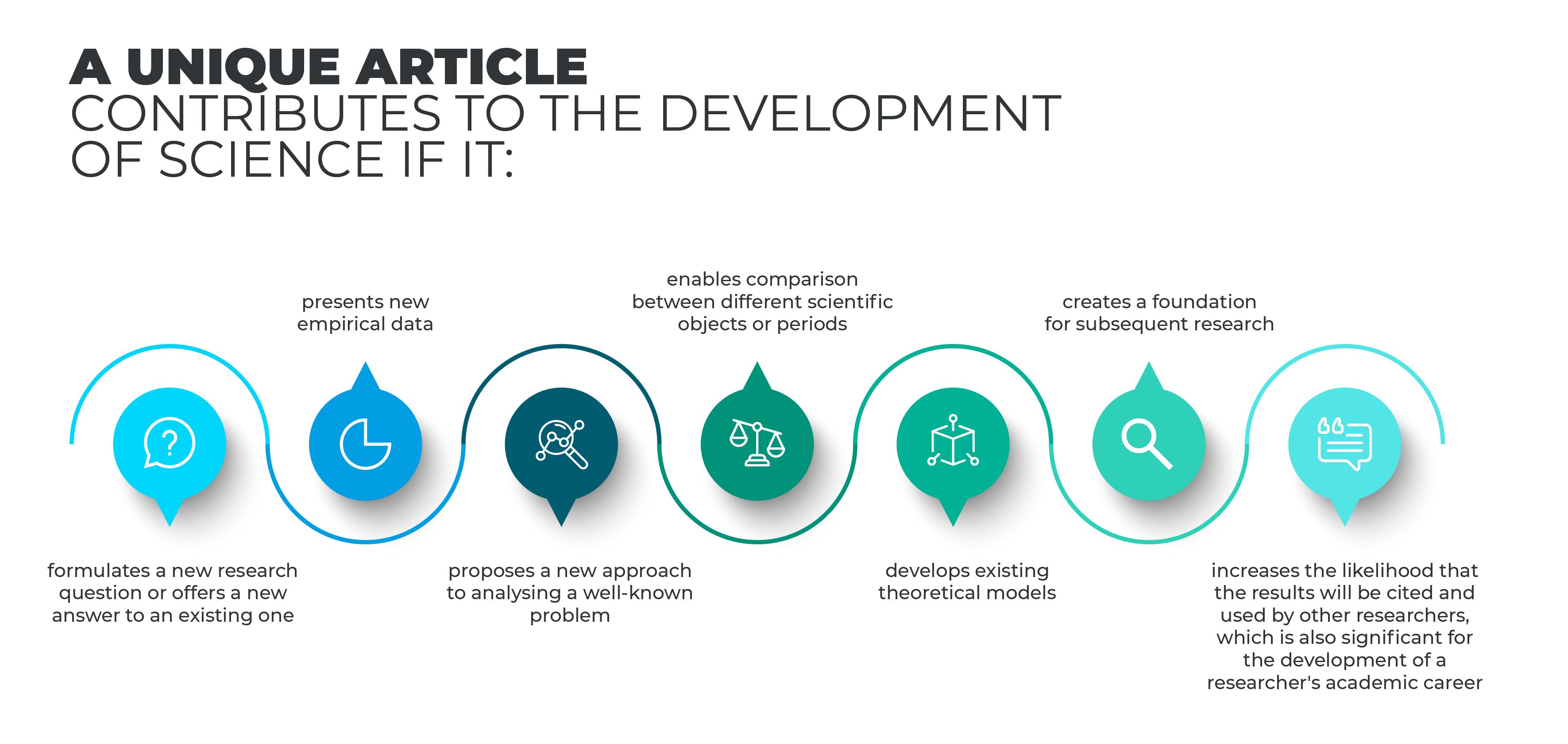
Thus, uniqueness is directly linked to the primary function of a scientific publication – that of adding new knowledge.
Academic integrity begins before publication
Academic integrity should not be interpreted solely as the absence of plagiarism. It presupposes a comprehensive approach to the creation, presentation, and publication of scientific results. The researcher bears responsibility both for the correct use of others' ideas and results, and for the reliability of their own data and conclusions.
Within the Bulgarian regulatory system, this principle holds specific significance. The Law on the Development of Academic Staff in the Republic of Bulgaria contains specific provisions concerning plagiarism and the unreliability of presented scientific data. This regulatory document governs matters relating to the presentation of others' work as one's own, as well as the use of published scientific results without appropriate reference or citation in certain academic procedures.
The legislation also provides for an institutional mechanism for reviewing reports of plagiarism and unreliable scientific data, through the Commission on Academic Ethics under the Minister of Education and Science. This demonstrates that academic integrity is not solely a matter of individual professional reputation. It constitutes part of the institutional organisation of the scientific system.
Uniqueness and the development of Bulgarian science
The question of the originality of scientific publications also has a broader national dimension. The National Strategy for the Development of Scientific Research in the Republic of Bulgaria for 2017–2030 sets out, among its objectives, the sustainable restoration of the country's international standing in terms of the quantity and quality of international scientific output, as well as an increase in the quantity and quality of scientific research related to problems of regional and national significance.
National scientific policy cannot be based solely on an increase in the number of publications. If Bulgaria is to strive towards a stronger international presence for its scientific system, it is necessary for published results to be recognisable by virtue of their scientific value.
A unique scientific contribution is precisely what allows articles to stand out amid the vast volume of scientific literature created worldwide each year. This, in turn, increases the visibility of a publication within the scientific world, as a result of which such works are cited more frequently. The researcher also gains a number of advantages: they may be invited to participate in grant-funded projects or joint research, and, in certain cases, invited to become an honorary reviewer for scientific journals.
In this sense, work aimed at increasing the originality of scientific publications is fully consistent with the national goal of improving the quality and international visibility of Bulgarian scientific output. The National Strategy remains in effect until 2030, and in 2024 an "Operational Plan for the Implementation of its Second Stage" was adopted.
Strategic documents define the overall direction of development; however, the actual quality of the scientific system is shaped at the level of individual pieces of research. In practice, this means that, already at the stage of preparing an article, several fundamental questions must be posed:
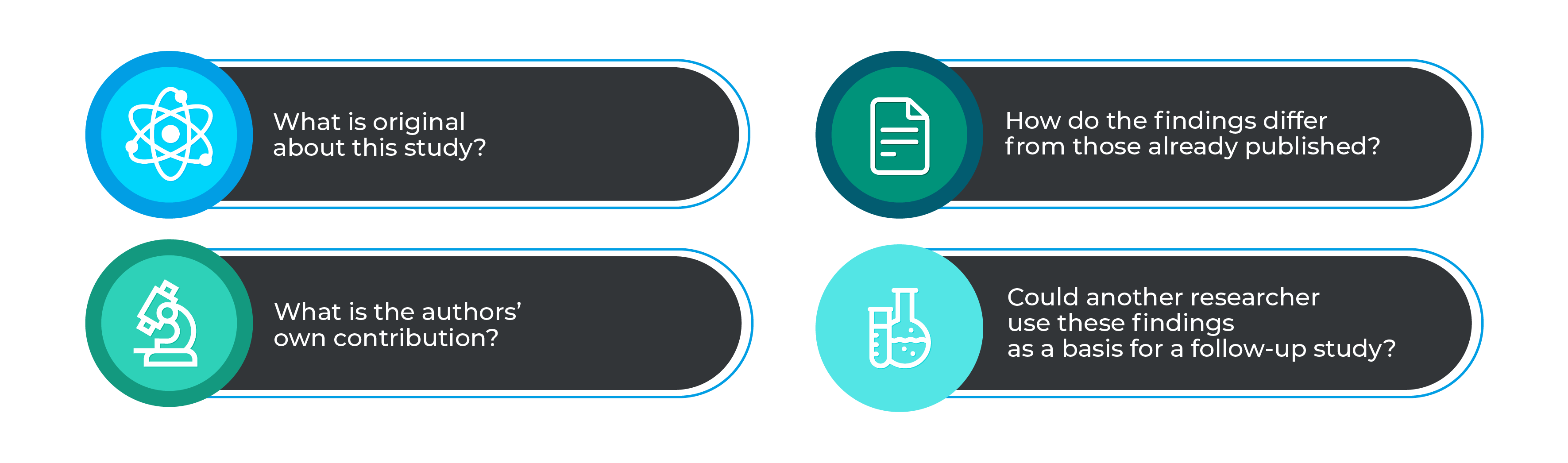
If there is no clear answer to these questions, the problem probably lies not only in the text of the article, but also in the underlying scientific concept of the research itself. Consequently, checking textual similarity should be merely one element of quality control. It is far more important to assess the scientific contribution of the material as a whole.
It is worth noting that the matter of originality is not confined solely to concerns about plagiarism or to the formal passing of a similarity check. The fundamental question ought to be a different one: does what we are publishing hold scientific value?
A plagiarism check is a necessary protective mechanism; however, on its own, it cannot guarantee the quality of a scientific study. A text may be formally original while still lacking a substantial scientific contribution.
For this reason, a responsible approach requires, simultaneously:
- Correct use and citation of others' scientific sources.
- Clear differentiation between known and new results.
- Presentation of reliable scientific data.
- Reasoned substantiation of one's own scientific contribution.
- Transparency regarding the methodology and limitations of the research.
- Critical assessment of the extent to which the results genuinely expand existing knowledge.
Responsibility does not lie with the author alone
Universities and scientific institutions play an important role in shaping an environment in which academic integrity is encouraged. Academic supervisors are responsible for cultivating sound research practices among young scholars. Reviewers must assess not only a manuscript's formal compliance with requirements, but also its scientific contribution. Editors and publishers, in turn, perform a key function in applying clear rules concerning authorship, citation, originality, and scientific ethics.
This is particularly important for the development of young researchers. The habit of working with original ideas, correct citation, and verifiable scientific data should be formed as early as the beginning of an academic career, at the stage of entering postgraduate study.
Uniqueness, academic integrity, and the quality of scientific results are interconnected. For an individual researcher, original material is a means of protecting their scientific contribution and professional reputation. For a university or scientific organisation, it forms part of institutional quality; for a scientific journal, it is a condition of trust in the content published; and for the national scientific system, it is a prerequisite for enhancing international visibility and sustainable development.
Separately, it is worth noting the use of AI technologies in the creation of scientific articles. These tools may serve as an aid in formatting literature, structuring text appropriately, and other supporting elements. However, they must not generate text in place of the author, as this is readily identified by modern quality-checking software. Should misuse of AI be detected in a piece of work, the sanctions will be the same as those applied in cases of detected plagiarism. This, in turn, jeopardises not only the very fact of publishing articles or monographs, but may also, in certain cases, lead to a researcher being barred from defending their dissertation.
Bulgaria already possesses regulatory and strategic mechanisms that place the quality of scientific output and academic ethics among the important elements of the development of scientific research. The next step lies in ensuring that these principles become everyday practice within the academic community. This matters because a strong scientific system is built not merely on a greater number of publications, but on reliable, original, and genuinely useful scientific results.
How does the Scientific Publications company verify the uniqueness of materials?
The Scientific Publications company not only assists with the refinement of scholars' research – articles, dissertations, and monographs. When carrying out textual work, our specialists always check the percentage of uniqueness of articles, as well as the percentage of AI use within the work. If the indicators fall below acceptable levels, the material is revised so as to meet high standards of quality. This, in turn, increases the subsequent chances of the material being accepted for publication.
In the case of projects such as dissertations or monographs, upon completion of each section, a separate report on uniqueness and on the minimal contribution of AI in the preparation of the work is provided alongside the revised text. In this way, by the time the work is complete, its uniqueness will be at a high level, which will allow it not only to pass the university's anti-plagiarism system check, but will also increase the chances of a successful defence and acceptance of the material by the academic supervisor.
Leave a request for a free consultation, and our specialists will acquaint you with current proposals for collaborative cooperation. Together towards new scientific achievements!