Today, science is developing at a rapid pace, and publications with multiple authors are becoming increasingly popular. However, creating a high-quality scientific paper often requires the efforts of a team consisting of specialists from different fields of science. Choosing the right co-authors is an important step that can have a significant impact on the success of a paper. In this article we will consider several effective ways to find co-authors for scientific publications.

In recent years, there has been a noticeable increase in the number of articles in the Scopus and Web of Science databases that are co-authored at the intersection of different disciplines. This format of cooperation allows sharing knowledge and expanding the boundaries of scientific thought. Working in a collaboration has many advantages. Each author makes a unique contribution, which makes the research more in-depth and versatile. In addition, the distribution of responsibilities and roles among co-authors greatly facilitates the process of working on the project. Another advantage of co-authored articles is the possibility to share the publication costs among all members of a research project.
At the same time, scientific collaboration can have some challenges. Collaboration with co-authors can be challenging due to differences in approaches to research design, degree of involvement, and writing styles. How to find suitable co-authors for future research projects?
What should you pay attention to when choosing a potential co-author?
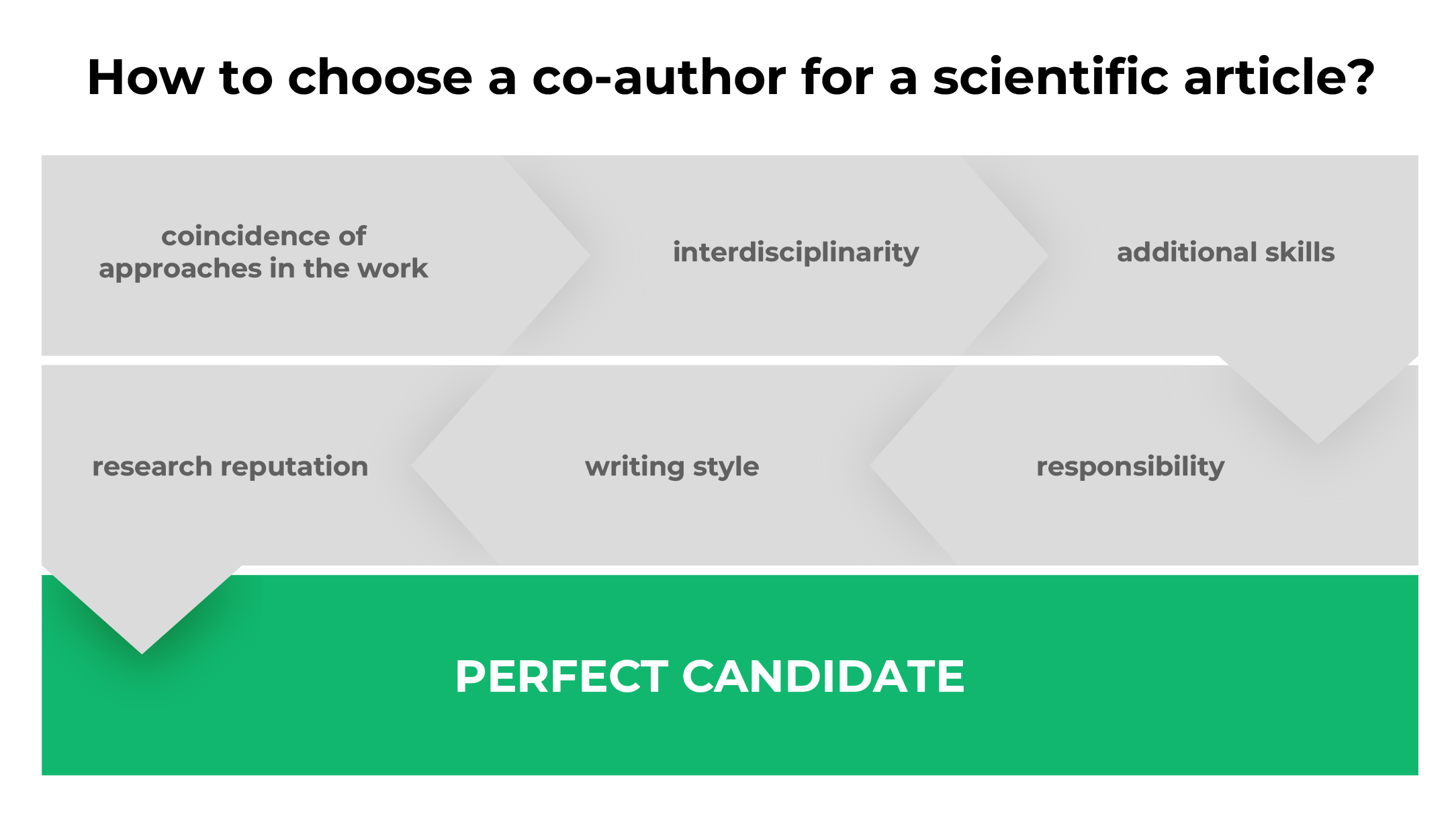
There are several important factors to consider when selecting a potential co-author:
- coincidence of approaches in the work: a similar or identical style in the work will simplify the realization of the scientific project
- Interdisciplinarity: research at the intersection of different disciplines has traditionally been more popular in academia, and thus more cited.
- complementary skills: collaboration is more productive if the co-author has skills that complement your own. This diversity of approaches will enrich the study and allow you to look at the problem from different angles
- responsibility: another quality to look for is work ethic. Assess how responsible a potential co-author is in terms of quality of research execution, meeting deadlines, and academic honesty? These criteria determine the success of the collaboration and the quality of the final result
- writing style: before proposing a collaboration, carefully familiarize yourself with the writing style of a potential co-author. Well-developed writing skills significantly increase the chances of publication in highly ranked publications
- researcher reputation: The co-author's Hirsch Index directly affects the recognition and citation of your collaborative work.
Requirements for co-authorship in Bulgaria
The requirements for co-authored articles are set out in the Act on "Academic Staff Development in Bulgaria". The allowed number of authors for publications in the international databases Scopus and Web of Science is limited to 3-5 co-authors, each of whom must prove a significant contribution to the research and writing of the scientific publication.
Many journals indexed by these services specify the requirements for the number of co-authors in the guidelines for authors.Usually the number of participants is limited to five, although in some cases exceptions are allowed depending on the specifics of the research.
It should be noted that the number of points for publication is distributed among all participants of the research project. To get the maximum possible number of points, it is recommended to either publish the article yourself or limit the number of authors to two participants.
How to search for co-authors for future research?
We have prepared a simple algorithm that will make the search for co-authors for your future scientific publications more efficient.
1. Define the aims and objectives of your research
Before you start looking for co-authors, it is important to clearly define the topic, aims and objectives of your research. This will help you understand which specialists may be useful for the realization of your research project. For example, if you are working on implementing AI technologies into business processes, you will likely need a programmer to implement the technologies and an economist to design the economic aspects of the research.
2. Look for collaborators in your academic environment
Universities and research institutes are ideal environments for finding co-authors. You can approach colleagues whose work is related to your area of research. Often co-authors are supervisors who have extensive experience in publishing research.
3. Participate in international conferences
Scientific conferences provide a unique opportunity to expand your professional contacts. You can meet colleagues who are working on similar topics, discuss ideas, and agree on joint projects. Participating in roundtables and panel discussions will help you find people with common research interests and goals.
4. Use specialized social networks for researchers
Modern digital tools make the process of finding co-authors easier and faster. Here are a few popular platforms you may find useful:
- ResearchGate
- Academia.edu
- Mendeley.
You can find scholars who work in your research area by keyword, institution, or publication.
5. Collaborate with researchers from other countries
In order to conduct more comprehensive and high-quality research, we recommend that you consider collaborating with international colleagues. For this purpose, you can use specialized platforms, participate in international conferences or join internships that bring together scientists from all over the world.
Looking for a co-author for publication but facing difficulties in finding a suitable candidate? We are ready to provide professional support! Scientific Publications cooperates with scientists all over the world from different fields of science. Our experts will help you find a co-author from your or a related subject area and ensure publication of high-quality research in accordance with the requirements of the selected journal. Leave a request in the form below and our manager will provide a detailed consultation.