For an objective assessment of one's own scientific activity, it is important to analyse not only one's own indicators, but also the results of other researchers. This makes it possible to evaluate one's own achievements in comparison with colleagues and to set realistic goals for further growth. In an exclusive article for the author's column, Vladislav Romanenko, director of the Scientific Publications company, explained in detail how to use the Bulgarian National H-index Ranking to carry out such an analysis.
Since scientometrics in Bulgaria is developing rapidly, a need has arisen over time to analyse and compare the scientific achievements of both universities and individual scientists.
Among all the resources currently available, the Bulgarian National H-index Ranking provides the most complete picture. This platform makes it possible to track both the rankings of universities and scientific organisations across the country according to citation index, and those of individual scientists within a particular institution.
The Bulgarian National H-index Ranking differs from other services in that, when compiling the rankings, Hirsch indices are taken into account not only from the Scopus database, but also from Web of Science and Google Scholar. More detailed information on the ranking methodology can be found via this link.
However, the site also has another useful option that is rarely used by scientists. This is the TOP 1000 Bulgarian scientists ranking, which ranks scientists according to their Hirsch index score in Scopus and Google Scholar (no ranking is kept according to the Web of Science database, since it is not yet as popular as the previous two).
Top-1000 scientists of Bulgaria in Scopus
If one analyses the positions of scientists within the Scopus database, it can be seen that the top places are occupied by scientists with a Hirsch index of 100 and above.
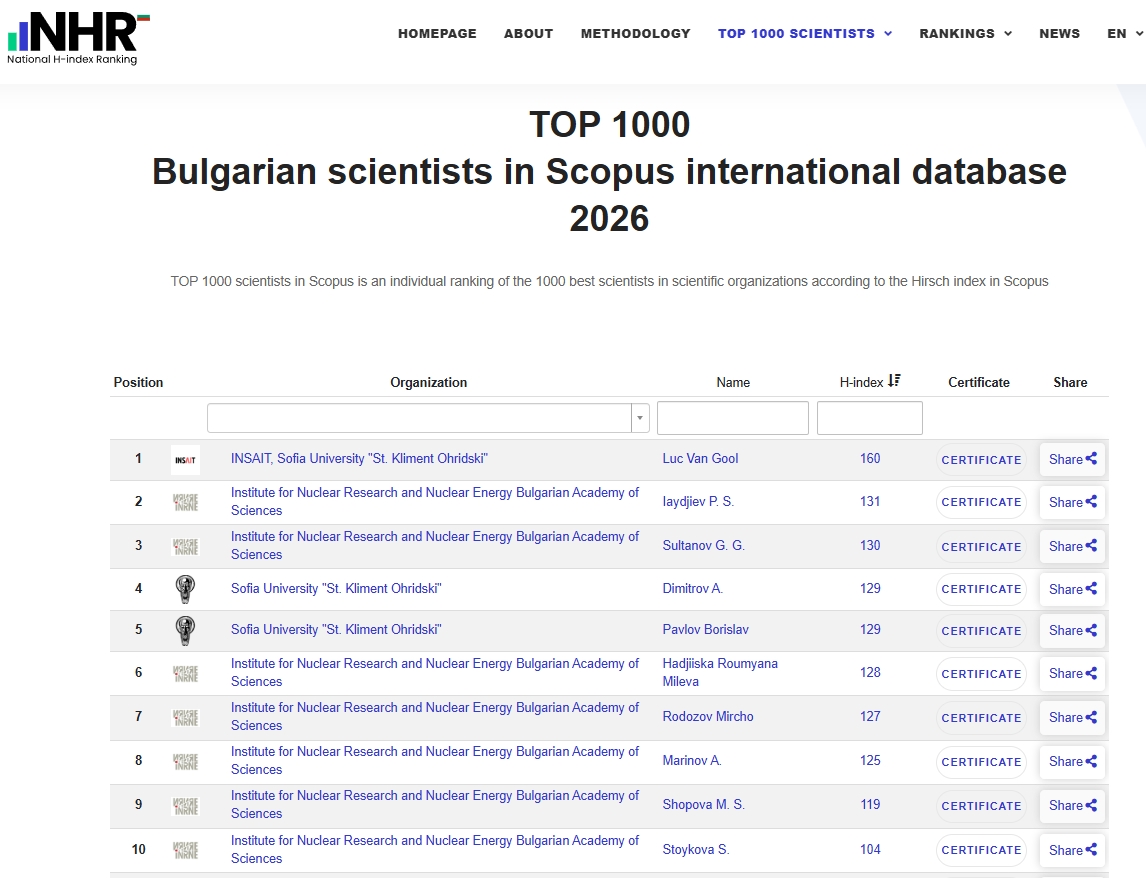
It is worth noting that most of the scientists who make it into the top 10 are representatives of the Institute for Nuclear Research and Nuclear Energy of the Bulgarian Academy of Sciences. This is explained by the fact that articles in technical sciences are cited by other scientists far more often than those in the humanities.
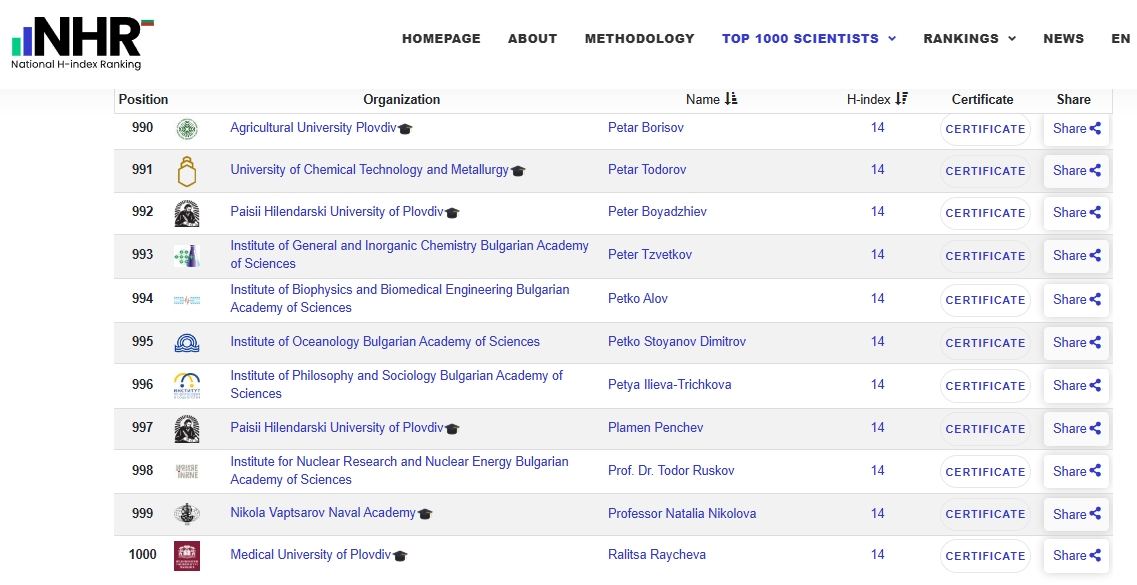
Scientists who do not have several hundred publications in Scopus in their profile will find it extremely difficult to occupy leading positions in the ranking. It is therefore better to focus on the final positions in order to get an idea of what the minimum Hirsch index is for making it into the Top-1000 scientists of Bulgaria.
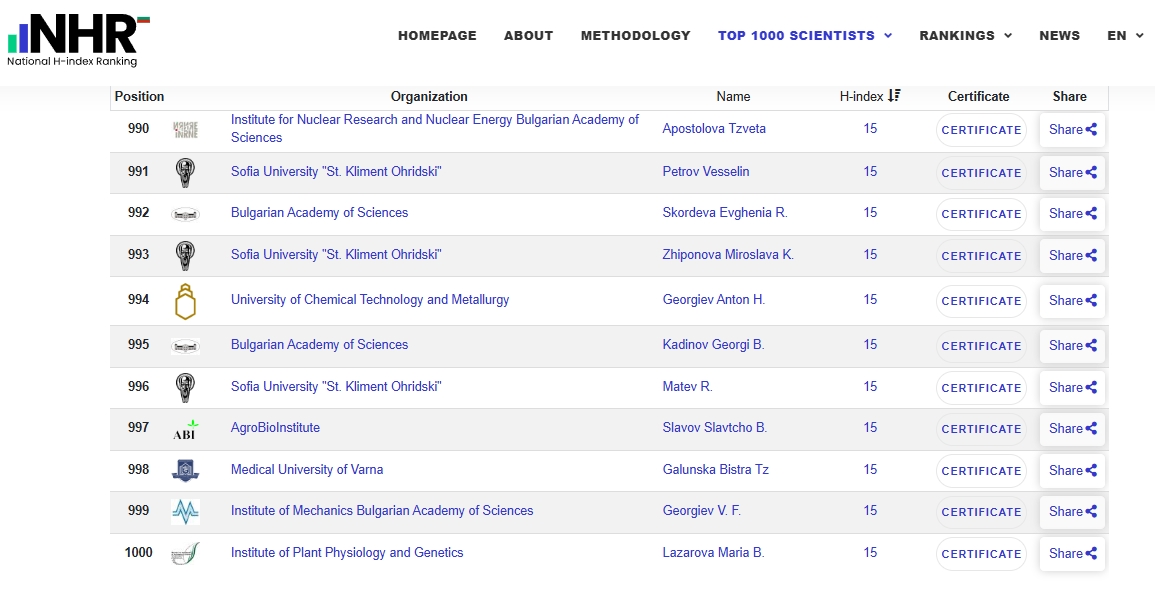
As we can see, in order to make it into this ranking, one needs to have a Hirsch index of at least 16, which means having at least 16 articles in the author's profile, each of which has been cited at least 16 times. Why exactly 16? The fact is that practically all researchers occupying the last hundred positions in the ranking have an h-index equal to 15. Therefore, in order to be included in the ranking, one needs an indicator at least one point higher.
Moreover, the Bulgarian National H-index Ranking is updated every year, which means that the arrangement of positions in the ranking may change if a scientist is actively working to increase the citation rate and visibility of their work. It should also not be forgotten that scientists are additionally awarded rating points for the citation of their articles in the Scopus database, which are necessary both for defending a dissertation and for obtaining positions at a university or continuing employment contracts.
Top-1000 scientists of Bulgaria in Google Scholar
If one analyses the Google Scholar search engine, the situation is slightly different. The positions of the leading scientists and their Hirsch index scores can be seen in the screenshot:
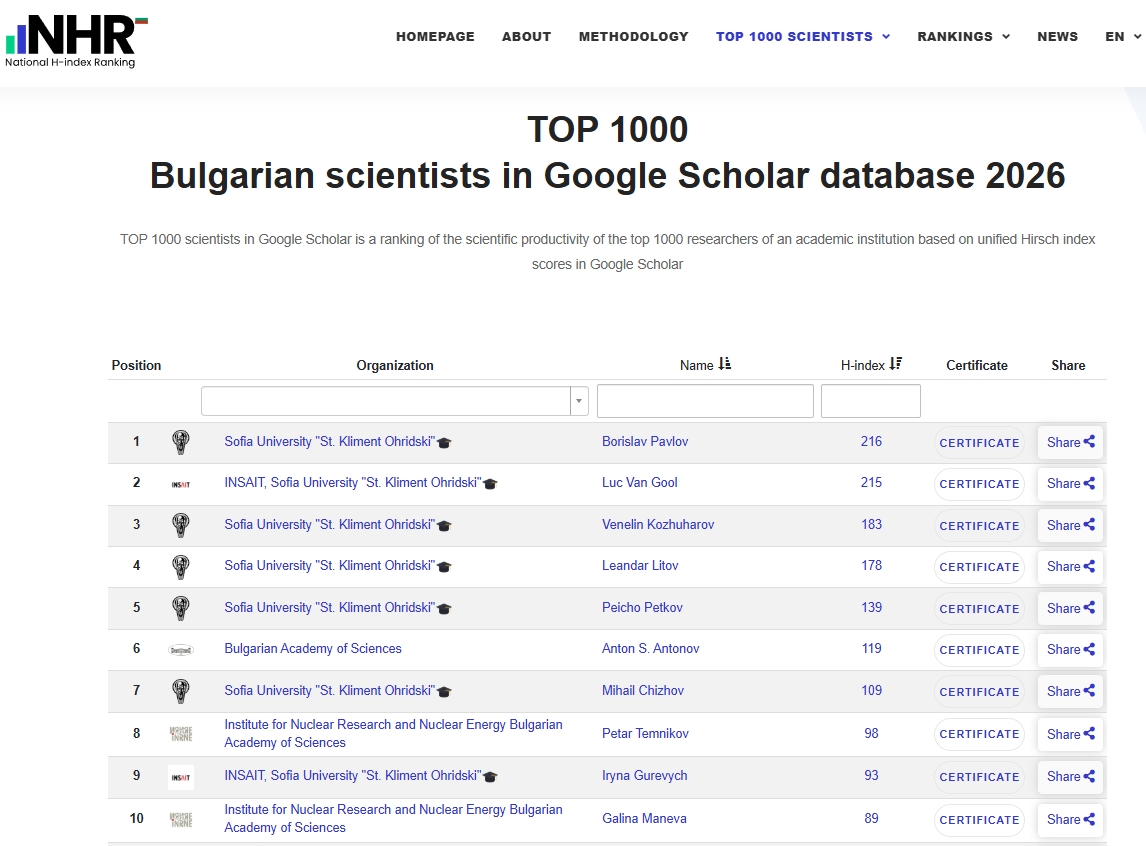
Here there are already more representatives of the country's leading university – Sofia University "St. Kliment Ohridski", and first place is occupied by a researcher with a score of 216. As for making it into the Top-1000 ranking according to the Google Scholar database, it is enough to have a Hirsch index of no lower than 15.
Since Google Scholar indexes practically all of a scientist's publications, including monographs, books and conference materials, the chances of making it into the ranking are considerably greater.
However, it should be borne in mind that, owing to the technical features of the Google Scholar search engine, it is not always possible to track the source in which an article was cited. And because of this, in some cases scientists may not be credited with rating points even with a high Hirsch index score.
The next update of the ranking is expected in November, and it is then that one will be able to track the current positions of scientists in the ranking and consider trying to make it into the national ranking of Bulgarian scientists. And if the current minimum indicators are still a long way off, now is exactly the time to start working on increasing the citation rate of one's own publications, since this process is quite time-consuming.
Scientific Publications company can assist in increasing Hirsch indices in the Scopus, Web of Science and Google Scholar databases, as well as organically and gradually raising citation indicators to the required values! Leave a request on the website, and our manager will prepare a personalised cooperation proposal for you based on an analysis of your author profile and current number of publications.