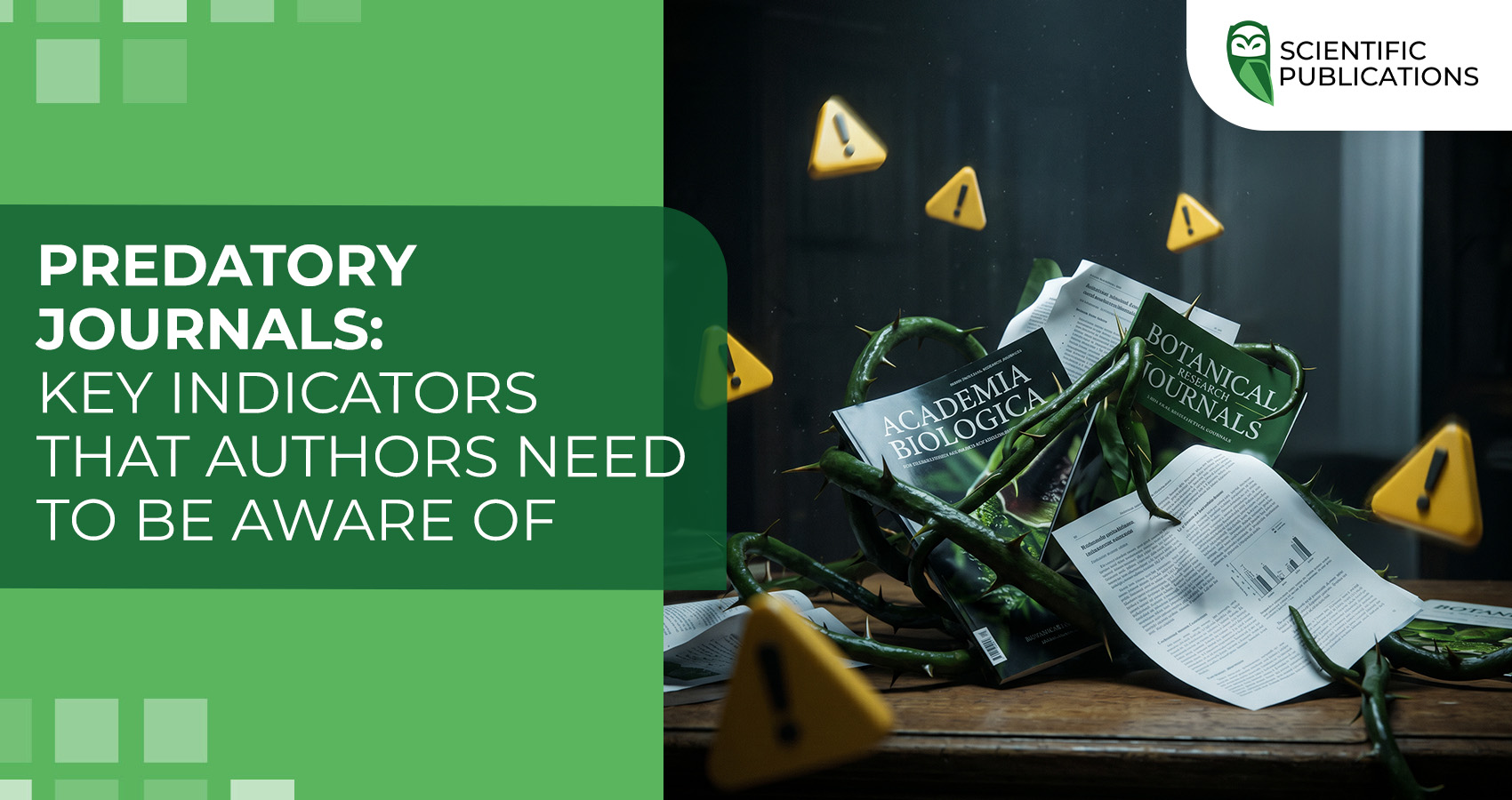
The visibility of an article is, to a large extent, influenced by the journal in which it is published. However, in the process of selecting a journal, there is a high probability of encountering fraudsters. In the academic environment, such journals are called predatory journals. How can they be recognised? What types of predatory journals exist? In today's article, we will discuss this in more detail.
What are predatory journals, and what may indicate their lack of integrity?
Predatory journals are academic publications that present themselves as reputable but fail to comply with generally accepted standards of peer review, quality and publication ethics. They charge a fee for publishing an article (APC – Article Processing Charge), yet do not provide genuine peer review, editorial oversight or long-term preservation of materials.
The term "predatory publishers" was first proposed in 2010 by American librarian Jeffrey Beall to describe disreputable publishers that mimic academic activity for the purpose of profit. Subsequently, the concept was extended to individual predatory journals as well.
In his criteria, Jeffrey Beall identified five main groups of signs that may indicate a lack of integrity on the part of a scientific journal or publisher.
| Category of criteria | Signs that may indicate a lack of integrity on the part of a journal or publisher |
|---|---|
| Editor and editorial staff | No information about the editor-in-chief or editorial board; researchers are included in the editorial board without their consent; no information about the editors' qualifications; the peer review process is not described. |
| Management of publishing activity | Information about the publisher, its legal address or contact details is concealed or entirely absent; the terms of publication and the size of the APC are not transparently defined; there is no information about the organisation that publishes the journal. |
| Integrity | The journal falsely claims indexing in international databases; uses fabricated or unreliable scientometric indicators; exaggerates its authority or provides false information about membership in professional organisations. |
| Other signs | Authors receive mass invitations to publish within a very short timeframe; the journal covers an excessively broad range of scientific disciplines; the website contains numerous language errors, and contradictory or incomplete information. |
| Low standards of the journal's operation | Peer review is formal or entirely absent; the editorial board promises publication within a few days; there are no policies on publication ethics, plagiarism or conflict of interest; articles are published without proper editorial processing; the requirements for authors are unclear or entirely absent. |
What types of predatory journals are there?
There is no universal, formally established standard for classifying predatory journals. However, in the publishing field, journals of this nature are conventionally divided into three main groups, which we will examine below.
1. Pseudo-journals
This layer of journals is mostly created from scratch and positions itself as an authoritative scientific publication. In order to add credibility to their activity, they falsify scientometric indicators and may also claim indexing in Scopus or Web of Science that does not, in fact, exist.
They often have no real editorial or publishing activity whatsoever – some do not even publish the article after receiving payment, but simply disappear or ignore further correspondence with the author. This is the simplest and most aggressive form of fraud in this field.
2. Clone journals
The mechanism of operation of such journals is quite simple: a fake website is created that imitates a genuine, already indexed (in Scopus or Web of Science) publication. It often has an almost identical name, design and even logo. The key difference from the original is a slightly altered URL address.
As a result, authors pay a fee, believing they are being published in a reputable journal, but the article never reaches the genuine editorial office, and the original journal itself may not even be aware that a fake exists.
3. Journals that have lost credibility (formerly "journals with authority")
These are publications that were previously genuinely indexed in Scopus or Web of Science but, over time, violated academic standards or ethical principles and were excluded from these databases, or are on the verge of exclusion.
The main danger of such journals is that they, as a rule, do not inform authors about the loss or risk of losing indexing, so a researcher may only find out about the problem after publication, when nothing can be changed.
How to avoid a predatory journal: instructions for authors
In order to minimise the chances of submitting an article to a predatory journal, several simple steps need to be taken to carry out a proper check of the publication.
Step 1. Check the journal's indexing in official databases
Do not rely solely on the information provided on the journal's website. If a publication claims indexing in Scopus or Web of Science, be sure to verify this yourself through the Scopus Source List or the Master Journal List from Clarivate. It is these official resources that contain up-to-date information about the status of the journal.
Step 2. Check the ISSN and the journal's official website
This step is very important, as it can help identify twin journals or fake web resources. Here is how to do it correctly:
- Analyse the information on the journal's website, including its ISSN.
- Check the journal's ISSN in the ISSN Portal (in the search results, you will see its official title, country of publication, publisher, resource status and other bibliographic details).
- Compare this information with what is stated on the journal's website.
If the title, publisher or country do not match, this may indicate a problem.
Step 3. Assess the peer review and publication timelines
Reputable journals undergo a full peer review process, which usually takes from several weeks to several months. Promises to publish an article within a few days or within one week are a strong reason for additional verification of the journal.
Step 4. Check the editorial board
Familiarise yourself with the composition of the editorial board and make sure that the listed researchers actually work at the relevant institutions and are genuinely associated with the journal. The absence of information about the editors, or the use of scholars' names without their consent, is a common sign of disreputable publications.
Step 5. Analyse the journal's subject matter and the composition of its authors
Check whether the published articles correspond to the stated subject matter of the publication. If a single issue combines works from completely different fields of knowledge, or if most of the authors represent only one or two countries despite the journal's declared international status, this may be a warning sign.
Step 6. Assess the quality of the journal's website
Pay attention to the quality of the website's design, the presence of an archive of issues, the correctness of links, the absence of grammatical errors, and the completeness of the contact information.
Despite the fact that predatory journals are a fairly widespread phenomenon, one should not think that they are impossible to recognise. By taking into account the recommendations outlined above, you will be able to protect yourself from making a mistake and choose a reliable journal for publication.
If you need the support of specialists in the process of publishing in international journals, contact the Scientific Publications company. Our team will help you select a quality journal and avoid fraudsters. In addition, our specialists will support you at every stage of publication, right up to the moment of indexing. Would you like to find out more? Then leave your contact details in the form below, and our manager will provide you with a free consultation. Together towards new scientific achievements!