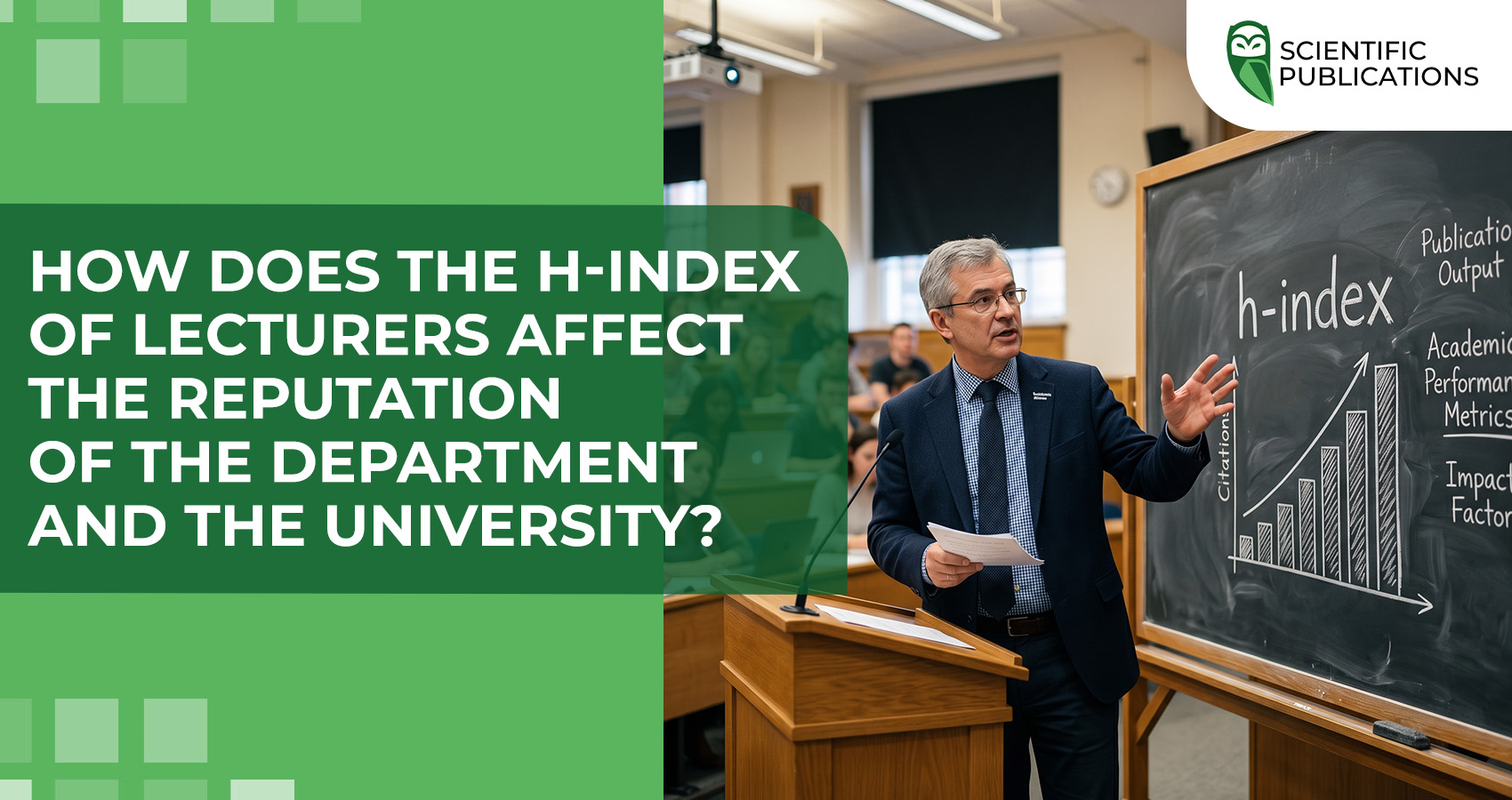
There are many myths surrounding the improvement of the h-index, and they often not only mislead researchers but can also hinder the enhancement of this indicator. One of the most widespread beliefs is that only authors who publish in Q1 journals have a high h-index. But is this really true? Does a researcher truly have little chance of achieving a high citation level without publications in top-quartile journals? Let us examine this issue in more detail.
How does the scientific journal quartile system work?
Quartiles – are a way of ranking scientific journals within a particular subject category based on citation indicators. In databases such as Scopus or Web of Science, journals are divided into four groups: Q1, Q2, Q3, and Q4.
- Q1 – the top 25% of journals by citation rate within the category
- Q2 – 25–50%
- Q3 – 50–75%
- Q4 – the bottom 25%
Due to this calculation principle, many authors believe that if your article is published in a journal read by thousands of researchers around the world, the likelihood of it being noticed and cited increases significantly. This is why publications in Q1 journals are traditionally regarded as the benchmark of scientific quality and a guarantee of high citation rates.
Does the quartile really determine the citation level?
A journal’s quartile reflects the average citation level of the publication as a whole, but it does not guarantee citations for an individual article. Within the same journal, both highly cited and barely noticed papers may coexist.
The citation rate of a particular work is influenced by, among other things:
- the relevance of the research topic to the scientific community
- the methodological quality of the study
- the novelty of the obtained results
- the accessibility of the material (including whether the journal provides open access)
- the clarity of presentation, as well as the practical and theoretical significance
It is also important to understand that in highly specialised disciplines, leading thematic journals often belong to Q2 or even Q3 simply because their audience is narrower, not because they are less authoritative. For a researcher working within a specific niche, publication in such a journal may prove to be strategically more beneficial than an article in a broad-scope Q1 journal, where it may become lost among a large number of other publications.
Why can the pursuit of Q1 journals alone harm your h-index?
First of all, it should be noted that publication in a high-quartile journal such as Q1 can indeed bring an author a considerable number of citations. However, it is important to understand that the publication process in such journals is often prolonged and may take a year or even longer. During this period, the research may partially lose its relevance, while the author may lose the opportunity to promptly present the results of their work to the scientific community.
Moreover, Q1 journals usually have a very high level of competition and strict manuscript requirements. Even high-quality articles are frequently rejected due to non-compliance with editorial policy, the narrow specialisation of the topic, or the limited number of publication slots available. As a result, the author spends a significant amount of time on multi-stage peer review, revisions, and repeated submission of the manuscript.
Another important aspect is that excessive focus exclusively on Q1 journals may significantly limit a researcher’s publication activity. For example, if an author spends several years trying to publish only one article in a highly ranked journal, they lose the opportunity to regularly publish the results of their research and receive citations.
Is it possible to have a high h-index without publications in Q1 journals?
It should be noted that the h-index is determined not by the journal quartile, but by the number of citations received by the author’s works. This is why a researcher may have a high h-index even without a significant number of publications in Q1 journals, provided that their articles are actively used by other scientists.
This is particularly noticeable in applied, interdisciplinary, or highly specialised fields, where the main professional audience is concentrated around specific thematic journals. In such cases, publication in a профильном Q2 or Q3 journal may provide much better visibility among the target audience than an article in a broad-scope Q1 journal.
It is also worth considering the role of open access. Studies that are freely available to a wide readership often receive more views and citations regardless of the journal quartile.
As we can see, the quartile of the journal in which you publish is not always a determining factor in the process of improving your h-index. In most cases, it is a well-planned and systematic publication strategy that can ensure the stable improvement of this indicator.
To simplify the process of improving your h-index and avoid difficulties, contact Scientific Publications. Our specialists will conduct an audit of your author profiles and develop an individual strategy for improving your indicators. Would you like to receive a free consultation? Fill in the form below, and our manager will contact you as soon as possible. Together towards new scientific achievements!