Researchers often seek to place their articles in Scopus-indexed journals that publish quickly. This is due to the fact that such publications have high authority, provide a wide audience coverage and, as a rule, offer fast publication deadlines. However, it is not an easy task to go through all the stages of publication quickly, even in such publications. Is it possible to speed up this process? Let's consider the main aspects affecting the speed of publication in Scopus journals in 2025.

How to promptly place an article in Scopus journals with fast publication?
1. Choosing the right journal is the key to reducing deadlines
The first and perhaps most important step is choosing the right journal. Many researchers make the mistake of submitting their work to high impact publications (Citescore, SNIP, SJR) without considering their long review periods. As a result, it can take six months or even longer to review an article. To minimise the wait, it is important to pay attention to these aspects:
- Speed of review. Some journals indicate on their websites the average time of reviewing an article. If this data is not available, you can write to the editorial office.
- Open Access or traditional model. Open Access journals often publish faster than those with a traditional business model.
- Subject matter relevance. If a paper is a perfect fit for the journal's specialisation, it will be reviewed more quickly than in a journal where the subject matter is considered controversial.
A competent choice of a journal can significantly reduce the time for initial review and avoid long delays in publication.
2. Correct article design and preparation for reviewing
Even if the ideal Scopus journal with fast publication is chosen, failure to comply with the publication's requirements may delay the process of article placement. Many authors often underestimate this stage, although it is extremely important. If an article does not meet the journal's requirements in terms of text length, structure, or citation style, the paper will be returned for revision immediately. This may be repeated several times, increasing the publication time by weeks or even months.
To avoid common mistakes, follow the following recommendations:
- Carefully study the journal's requirements and format your article in strict accordance with them
- Prepare a cover letter to the editor. A short but informative letter justifying the relevance of the paper can influence the speed of the initial review.
- Check the article for originality. If the uniqueness of the text is insufficient, the article will be returned.
- Avoid complex constructions and stylistic errors. If the article is difficult to read, reviewers may spend more time analysing it.
Careful preparation of the article avoids unnecessary delays and increases the chances of getting through the review process quickly.
3. Effective communication with reviewers
Even a perfectly written paper goes through a review stage where additional delays may occur. To speed up the process, it is important for the author not just to wait for a response, but to actively participate in communication with the reviewers. If the journal has not responded by the deadline, a polite reminder to the editor can speed up the review process.
Follow these guidelines to successfully pass the review stage:
- Respond to reviewers' comments in a consistent and reasoned manner. If you do not agree with the comments, you should explain why
- Make a corrected version with notes on the changes. This will simplify the reviewer's work and speed up reconsideration.
- Do not delay in sending the revised version. The sooner you send the article with corrections, the sooner the work will be returned for reconsideration.
Fast publication in Scopus is possible, but requires high-quality preparation. Proper selection of a journal, careful study of the article and active interaction with the editorial board can reduce the time and increase the chances of successful placement of the paper in the international database.
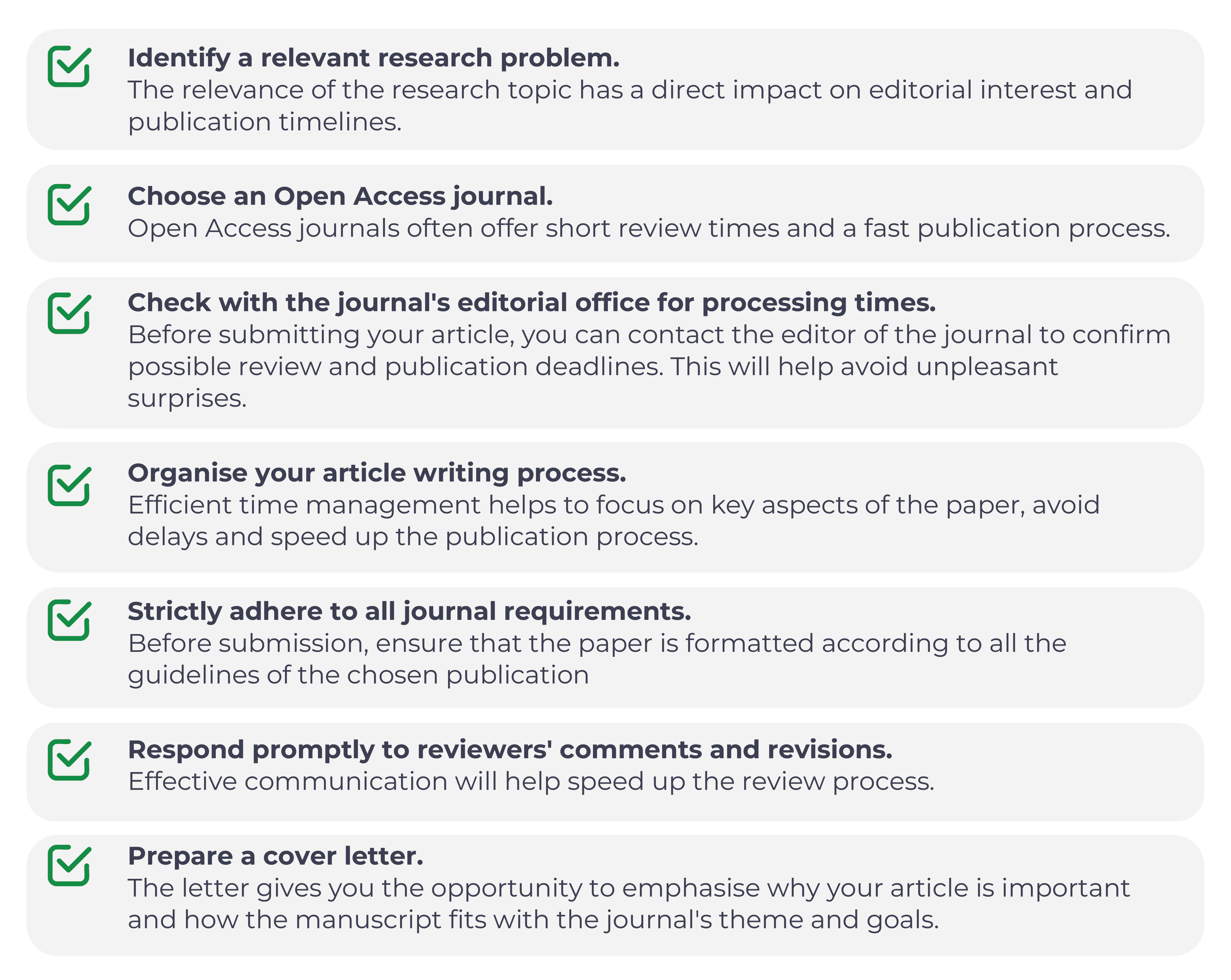
Checklist: How to speed up the process of publishing in Scopus?
List of journals indexed in the Scopus database that publish articles quickly
Below we have listed a list of fast-publishing journals – Scopus Indexed Journals 2025 – known for high authority and citations.
Journals with rapid publication in Scopus are represented in the following subject areas:
- health, medicine
- mathematical sciences
- social sciences
- natural sciences
- humanities
- computer sciences
- computer science
- artificial intelligence (AI)
- engineering
- veterinary medicine
- related fields (interdisciplinary sciences).
|
№ |
Journal title |
ISSN / E-ISSN |
Subject area |
|
1. |
International Journal of Human Movement and Sports Sciences |
2381-4381 / 2381-4403 |
|
|
2. |
Advances in Mathematics: Scientific Journal |
1857-8365 / 1857-8438 |
|
|
3. |
International Journal of Computing and Digital Systems |
E-ISSN: 2210-142X |
|
|
4. |
Journal of Renewable and Sustainable Energy |
E-ISSN: 1941-7012 |
|
|
5. |
International Research Journal of Multidisciplinary Technovation |
E-ISSN: 2582-1040 |
|
|
6. |
Journal for ReAttach Therapy and Developmental Diversities |
E-ISSN: 2589-7799 |
|
|
7. |
Archives of Civil and Mechanical Engineering |
1644-9665 / 2083-3318 |
|
|
8. |
Journal of Namibian Studies |
1863-5954 / 2197-5523 |
|
|
9. |
Journal of Survey in Fisheries Sciences |
E-ISSN: 2368-7487 |
|
|
10. |
Linguistic and Philosophical Investigations |
1841-2394 / 2471-0881 |
|
Fast publication in Scopus is possible if you choose the right journal and carefully prepare the article, following all the recommendations of the publication.
Scientific Publications has been helping scientists from all over the world to publish scientific articles in Scopus within a short period of time while meeting the strict requirements of peer-reviewed journals for more than 8 years. Our experts will select Scopus journals with fast publication, help you pass the difficult peer-review stage and index your article in the database.
Leave a request for a free consultation and we will tell you how to quickly publish your article in Scopus.