In this section, authored by the Director of the company Scientific Publications, Vladislav Romanenko, suspicious journals will be analysed for violations of publication ethics, editorial standards, and the generally accepted requirements of the Scopus database, so that such journals may subsequently be identified even at the stage of considering publication options and researchers may avoid submitting their manuscripts for peer review to such publications.

A striking example of a journal engaged in suspicious activity – is the INTERNATIONAL JOURNAL OF ADVANCES IN SIGNAL AND IMAGE SCIENCES.
First and foremost, it is worth noting that the journal is making every effort to attract authors to publish in it by stating on its website that it is indexed in the Scopus database with a first quartile ranking as a leading international journal.
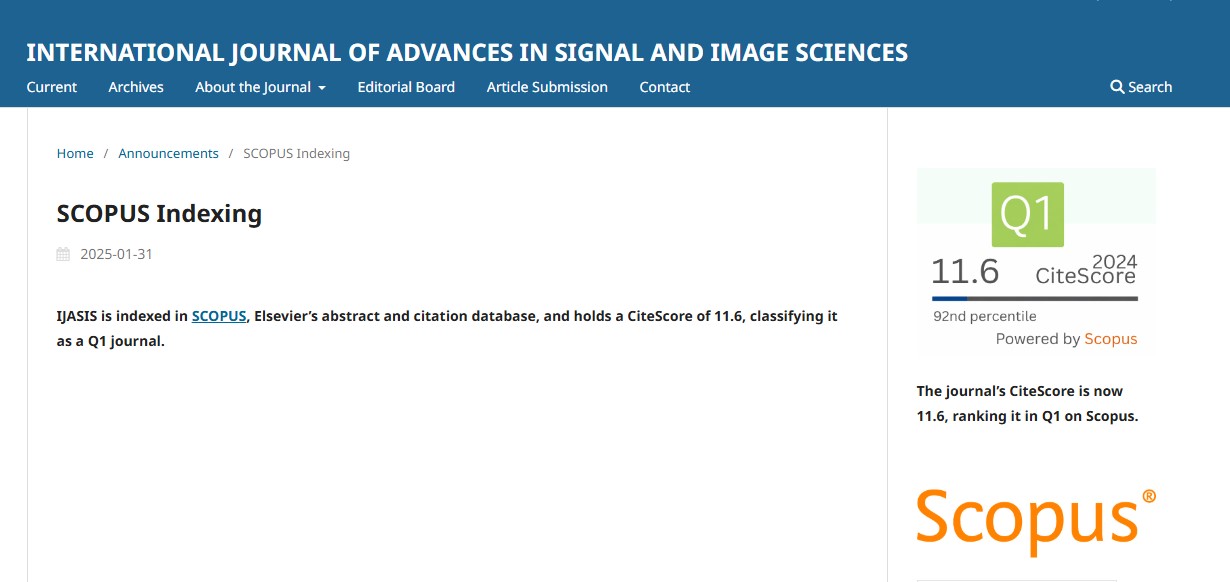
However, attentive researchers will notice that the date of the announcement is stated as 31 January 2025, which in itself may already raise concerns. Indeed, when the journal is checked through the official Scopus database website, the journal does appear in the system search results, but with a note stating that it was indexed in the database only until 2025.
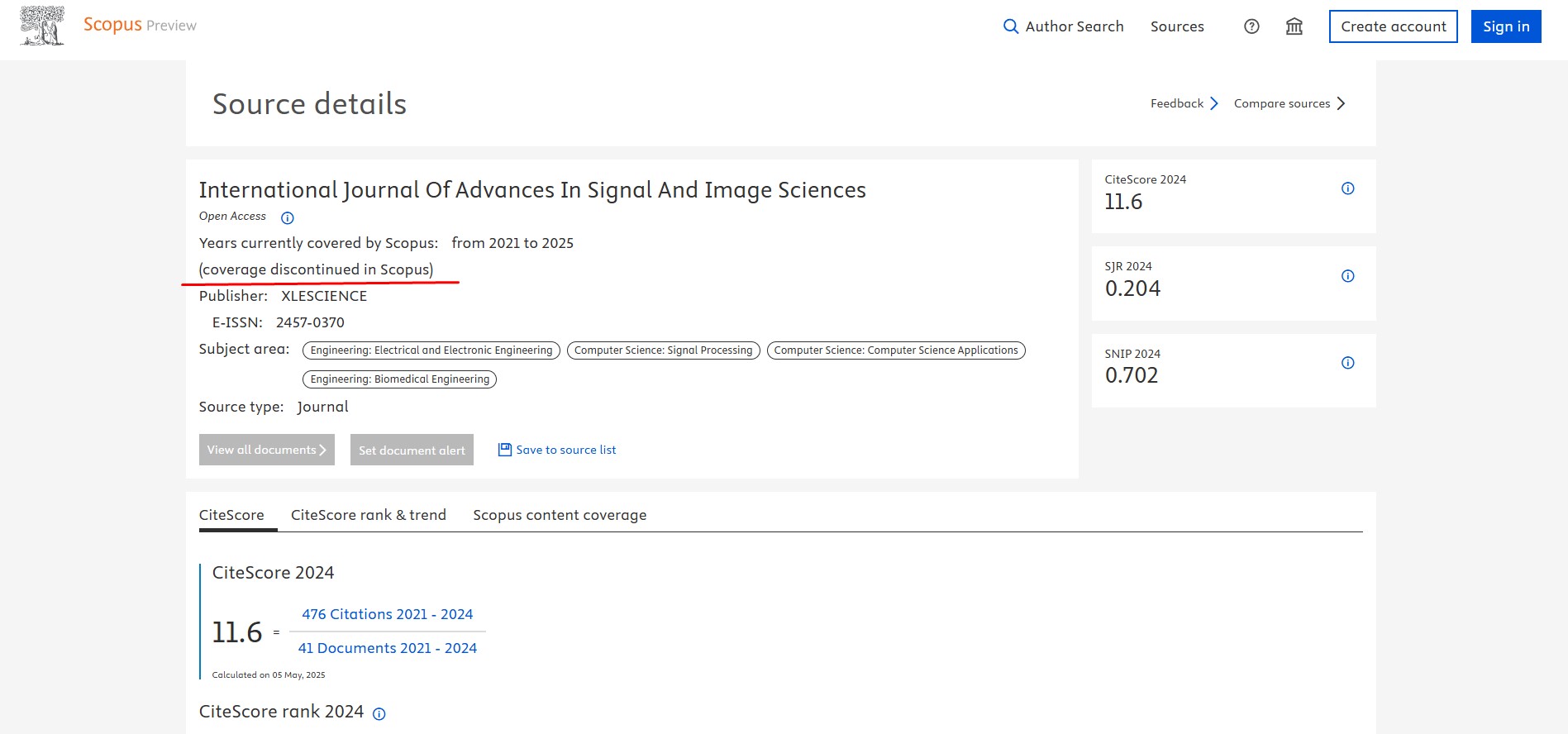
What could have been the reason for the journal’s exclusion from the database if it had been among the highest-ranked journals (Q1) in its scientific field?
My colleagues and I examined this issue and discovered that, as is often the case with journals of this kind, the explanation lies in the journal’s publication activity. Prior to the journal’s inclusion in the database, it regularly published two issues per year with no more than five articles per issue. After being indexed in Scopus in 2025, the publication activity of the journal increased dramatically.
Whereas from January 2025 onwards issues began to contain more than ten articles, by the end of the year the number of articles per issue had already reached approximately one hundred, while the electronic version of an issue exceeded 1,500 pages. Moreover, in addition to the regular issues, special issues also began to be published, and several times per year at that. This became one of the reasons why the journal attracted the attention of the Scopus ethics committee.
Another reason that also appears highly suspicious is the mismatch between the articles and the journal’s stated thematic scope. Thus, before inclusion in the database, all articles corresponded to the declared scope of the journal (all fields of science and engineering, but not limited to advances in data, signal, and image processing and its applications).
After inclusion, the first special issues still attempted to correspond to the journal’s subject matter; however, beginning with Vol. 11 No. 5s (2025) and Vol. 11 No. 6s (2025), articles from the fields of law, medicine, education, economics, and other scientific disciplines can already be observed.
You may also pay attention to the number of authors included in the authorship lists that were accepted for publication in the journal.

One would assume that following exclusion from the database, the journal’s publication activity would decrease to acceptable levels in order to improve its chances of restoring its indexing status. However, despite being excluded from the database, the journal’s website still contains announcements claiming indexing in Scopus and on the Scimago platform. Furthermore, considering the number of articles and special issues published this year, the journal continues to accept hundreds of articles while deliberately misleading authors. At the same time, the editorial office charges considerable publication fees.
The situation appears to be an attempt to profit easily from unsuspecting researchers, where short-term indexing in the Scopus database became a reason to abandon all accepted publication standards and place the pursuit of financial gain above scientific publication ethics. It is difficult even to imagine the scale of reputational and financial losses suffered by researchers.
Therefore, even at the stage of considering this journal as a potential publication venue, researchers should pay attention to the following combination of factors:
- The absence of contact details for real representatives of the journal on the journal’s website;
- The editorial board is not listed;
- An unnaturally large number of articles and special issues (a reputable journal, especially one with a Q1 ranking, cannot reasonably have three times more special issues than regular issues).
By understanding what to pay attention to when selecting a journal, researchers can learn to identify predatory publications and distinguish them from genuinely reputable journals indexed in the Scopus and Web of Science databases.
The specialists of the company’s publication department not only select suitable journals for publication in cooperation with researchers, but in the event of problems with a journal, they also help identify alternative publication options. In such cases, the company Scientific Publications serves as a guarantor of the quality of the services provided, saving researchers considerable amounts of time otherwise spent selecting an appropriate journal, verifying its publication practices, and assessing compliance with ethical standards.
At the same time, it is equally important to note that even when selecting a high-quality journal that publishes articles within your field of scientific interest, you are not guaranteed protection from rejection following the peer review process, which may sometimes take several months or even up to half a year.
Submit an application for article publication, and our managers will ensure the highest quality of service and support at every stage of the publication process.