When publishing scientific articles, every researcher aims to popularize their work and gain recognition among other experts. One of the important indicators in this process is the H-index. It is worth noting that this metric is one of the most significant as it reflects the activity and impact of a researcher. Thus, publishing scientific papers is not the ultimate goal but rather an incentive for further work. It is a time when a researcher should consider how to attract attention to their work and increase its popularity and citation.

The H-index was proposed in 2005 by Professor of Physics Jorge Hirsch with the aim of quantitatively assessing the citation impact of an author or research organization. Among other metrics of effectiveness, the following can be highlighted: m-index, g-index, i-index, individual h-index, a-index.
How to calculate the H-index
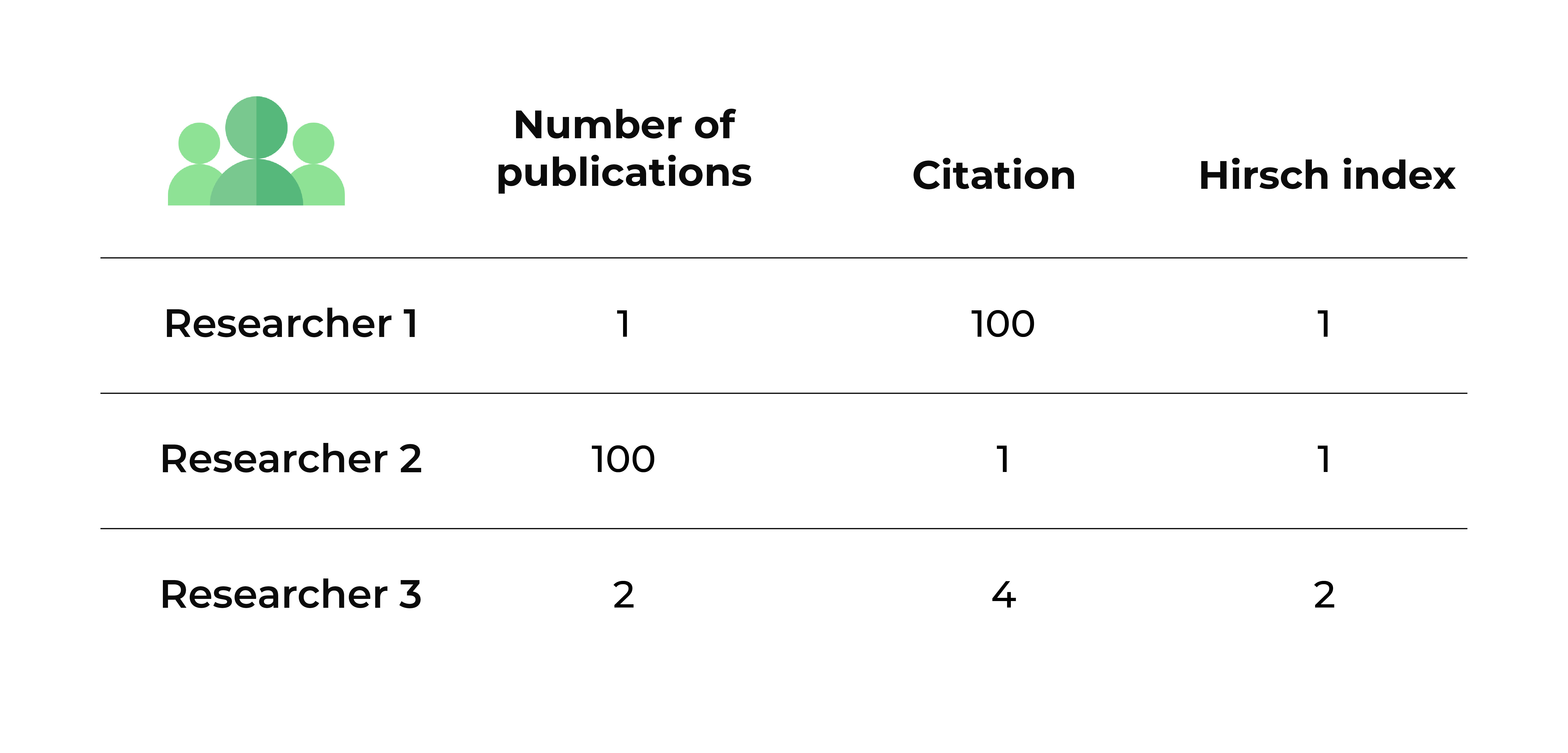
Formula for determination: The calculation of the H-index can be defined as the interdependence of the number of citations to the number of scientific papers.
Hirsch Index = 10 means that in the author's profile, there are at least 10 articles, each of which has at least 10 citations.
How to find the Hirsch Index in Scopus and WoS databases?
To determine the h-index in Scopus and WoS, it is necessary to perform a search by author or view the profile of a specific researcher. Additionally, the h-index in Web of Science can be obtained through the Publons platform.
What does the Hirsch Index influence, and what results can be obtained considering this metric?
-
The Hirsch Index influences the level of importance of a scientist and their research. This metric highlights the author's works among others, showing that this particular researcher is cited more frequently, thus making their works more popular and attracting the attention of a larger audience interested in science.
-
The metric is directly essential for the author to gain scientific recognition. If a researcher has a high H-index, it automatically attracts an audience to their work and includes them in the community of the most recognized researchers.
-
The more citations a researcher's works receive, the higher the H-index will be. A high number of citations contributes to the recognition of the scientist's authority.
-
Additionally, the metric is crucial in terms of achieving the researcher's scientific goals. A scientist's research can be considered successful if it is cited and known to as many interested individuals in the scientific community as possible.
-
In terms of a researcher's influence, having a high H-index increases the chances of obtaining financial support and grants. Grant programs are extremely important for scientists as they facilitate the unhindered progress of their projects.
-
Furthermore, recognition of a scientist enables them to become a member of an editorial board or a reviewer, which contributes to a successful career and attainment of prestigious positions.
-
A high Hirsch Index provides an opportunity for a scientist to conduct more extensive research and publish in high-impact journals.
For example, Sigmund Freud has the highest h-index, which is 275. Typically, Nobel laureates have an h-index higher than 100.
What opportunities does the use of this metric open up?
-
The scientist can use the metric to understand the effectiveness of their work and adjust it if the index is low.
-
They can also review the correctness of the formatting of the work and its substantive content.
-
Additionally, the researcher can be more careful in selecting a journal for publication, considering the audience and the publication's popularity.
Disadvantages of the Hirsch Index:
-
The Hirsch Index graph does not consider temporal parameters, so in more experienced scientists, this metric may be higher than in researchers with fewer publications.
-
The interdependence between the number of publications and citations practically eliminates the significance of highly cited works, as a greater number of publications can artificially increase the Hirsch Index without considering the quality and impact of specific works.
-
A high Hirsch Index is not characteristic of researchers working in narrow fields or dealing with specialized topics.
How can the Hirsch Index be increased?
To increase the Hirsch Index, a scientist should approach this task comprehensively. From conducting research to publishing materials, many nuances should be considered. For example, scientific results should be published only in the most prestigious journals, where they will be found and evaluated by other experts.
— The research should be relevant and address deeply studied issues to engage and build an audience.
— It is important to ensure that all author information and work metadata are correctly provided when submitting an application (metadata includes title, abstract, and keywords).
— One way to increase the h-index is to collaborate with well-known authors to create scientific materials (such works gain more visibility).
— Self-citation is also an important method, but the number of references to one's own work should not exceed 12-13% of the total number of sources.
It should be noted that some bibliometric databases do not consider authors' citations of their own articles when calculating the Hirsch Index!
— To promote your research and increase interest in it, utilize social media. You can share news about your work on LinkedIn or visually present an excerpt on a slide on any other social network.
— Additionally, registration on ResearchGate contributes to increased citation levels. It is a social network for scientists where you can find useful contacts and promote your scientific work in the academic world.
The strategy for increasing the index encompasses the relevance and novelty of the article, selecting the right publication, correct formatting of the work and metadata, and author promotion.
It's important to remember that a low number of citations to an author's work in Scopus, Web of Science, or Google Scholar doesn't always indicate low-quality scientific articles. Often, such issues arise due to technical errors, such as incorrect formatting of the author's profile.
The company "Scientific Publications" is ready to help you organically increase your H-index, which will provide more coverage and interest in your work. Contact us!