To advance their scientific careers, every researcher strives to do everything possible. Therefore, it is quite understandable that one of the steps scientists consider in this direction is publishing articles in bibliographic databases such as Scopus and Web of Science.

At first glance, the most important aspect of this process seems to be the choice of a journal for publication, which should correspond to the field of knowledge and necessary bibliometric indicators. However, there are many other nuances in working with Scopus. For instance, when checking a journal's indexing, attention should be paid to:
-
Database updates;
-
The integrity of the publication;
-
Specifics of journal release frequency and Scopus coverage years;
Verification of indexing in Scopus
Scopus is a dynamic database where indexed publications can quickly change information about their activities.
Step one:
-
Log in to the Scopus database;
-
Choose the journal search option;
-
Enter the necessary query and go to the publication page;
-
If the journal is not found, it means it has never been indexed in Scopus;
The label "coverage discontinued in Scopus" indicates the cessation of indexing;

Step two:
-
Download the list of indexed publications (you will see a table in front of you). Here you can check the indexing of the publication;
Download the list of source titles
Complex cases of determining indexing:
1. The "to present" label
Example of a journal: Journal of Somaesthetics

-
The "to present" label means that the journal is indexed in the database. However, exceptions indicate that the Scopus coverage years of this journal are limited (for example, "from 2019 to 2023"), but there is no indication of the exclusion of the publication.
Why is the publication indexed? Check if materials for 2024 have not been indexed. Also, look at the "coverage discontinued in Scopus" label. Download the list of indexed publications and find the necessary one, paying attention to the "Active" label (indicated in the Scopus coverage table).
The Journal of Somaesthetics is indexed in Scopus, but since 2023, no materials have been received from the journal for indexing. This means that during these years, the journal did not submit materials for indexing. If a publication does not submit materials for three years, it will be labeled "discontinued."
2. Indexing for future issues:
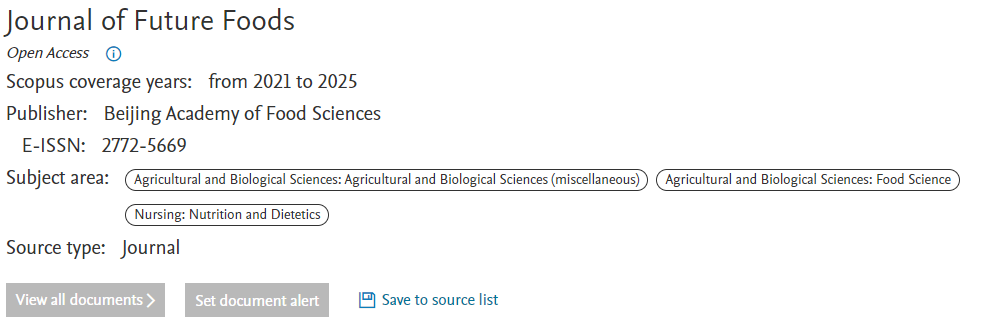
Example of a journal: Journal of Future Foods
-
Its indexing in Scopus covers the period up to 2025. To check the indexing, go to the "Scopus content coverage" tab. Materials for 2025 are also indexed.
The Journal of Future Foods is indexed in Scopus until 2025, as the journal has already formed issues and indexed them by the specified time.
3. New and excluded journals

-
Sometimes Scopus lacks information about a journal's indexing. However, the journal may already be included in the database. Check the required publication in the Scopus coverage table and find it there. The publication may be new, so the page in the database has not been created yet. It will appear when the journal's editorial board forms an issue and indexes it in Scopus.
The same can happen with the "coverage discontinued in Scopus" label. The system may display this label sometime after the official exclusion.
To resolve this situation, it is recommended to check the information using the Source List, which is updated approximately in the middle of each month.
4. Information updates:
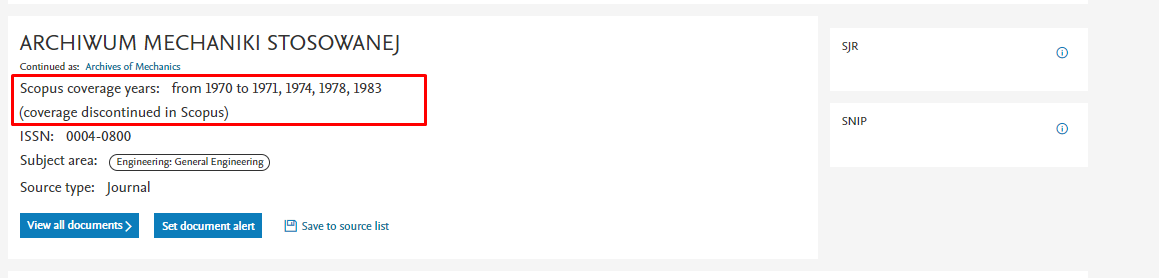
Example of a journal: ARCHIWUM MECHANIKI STOSOWANEJ
-
Will the journal ARCHIWUM MECHANIKI STOSOWANEJ be indexed in Scopus? Yes, but under a new name. To check this, go to the publication page and pay attention to the "coverage discontinued in Scopus" label. However, we also pay attention to "Continued as."
By following the link of the new name of the publication, we see that the page is active, and the journal is indexed in Scopus.
The journal ARCHIWUM MECHANIKI STOSOWANEJ is indexed in Scopus but under a new name.
5. Checking the indexing of excluded journals:
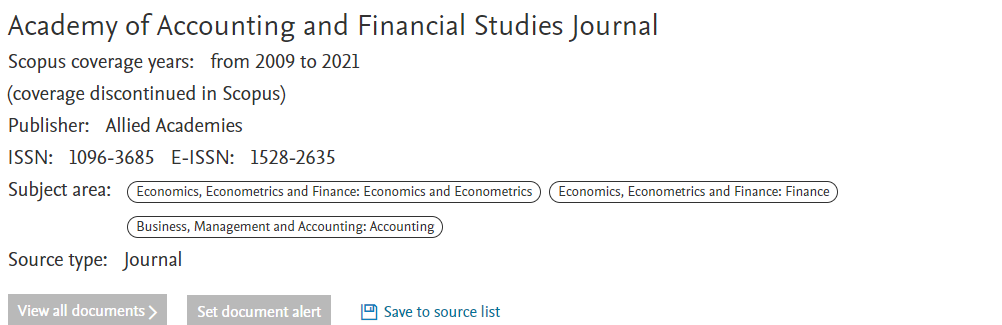
Example of a journal: Academy of Accounting and Financial Studies Journal
-
Exclusion from Scopus in 2021 does not prevent us from finding 181 indexed materials of this publication for this year.
This check can be done through the Scopus content coverage label.
Note that it is not advisable to use resources such as Scimago Journal Rank to check the index, as the information in this system is updated once a year, while in Scopus it is updated monthly.
The company "Scientific Publications" is ready to assist you in publishing your materials in the Scopus and Web of Science databases and to consult you on any relevant issues that may arise. Contact us and order quality work that will save you time and effort.