In Bulgaria, the process of obtaining academic degrees and scientific titles in the field of social, economic and legal sciences is carried out in accordance with the Academic Personnel Development Act in the Republic of Bulgaria and related regulations. The awarding of scientific degrees (Doctor, Doctor of Science) and academic titles (Principal Assistant, Associate Professor, Professor) is on a competitive basis and depends on the amount of points achieved. This article details the nationally defined minimum requirements that candidates must fulfil in order to obtain degrees and titles in the social, economic and legal sciences.

Which sciences are categorised as social, economic and legal sciences in Bulgaria?
According to the Act on the Development of Academics in the Republic of Bulgaria the category of social, economic and legal sciences includes:
- Sociology, anthropology and cultural studies
- Psychology
- Political Science
- Social sciences
- Social communication and information sciences
- Law
- Administration and management
- Economics
- Tourism.
How to obtain a degree or academic title in the field of social, economic and legal sciences?
The procedure for obtaining a degree or scientific title in the field of social, economic and legal sciences in Bulgaria is clearly regulated by the Law.
The national requirements for obtaining a doctoral degree presuppose successful defence of a thesis, completion of doctoral studies and passing all the prescribed examinations, as well as confirmation of scientific qualifications through a number of additional academic achievements. These include publications in reputable international databases such as Scopus and Web of Science, publication of monographs and books, registration of patents and inventions, and citations of articles (high Hirsch index).
Awarding of scientific degrees (doctor, doctor of sciences) and scientific titles (chief assistant, associate professor, professor) is carried out on a competitive basis. Candidates are evaluated according to a point system: the more points an applicant scores for his/her scientific achievements, the more chances he/she has of successfully defending his/her thesis and being awarded a degree/title.
In our previous material we have considered in detail the requirements and the procedure for awarding the academic title of "professor".
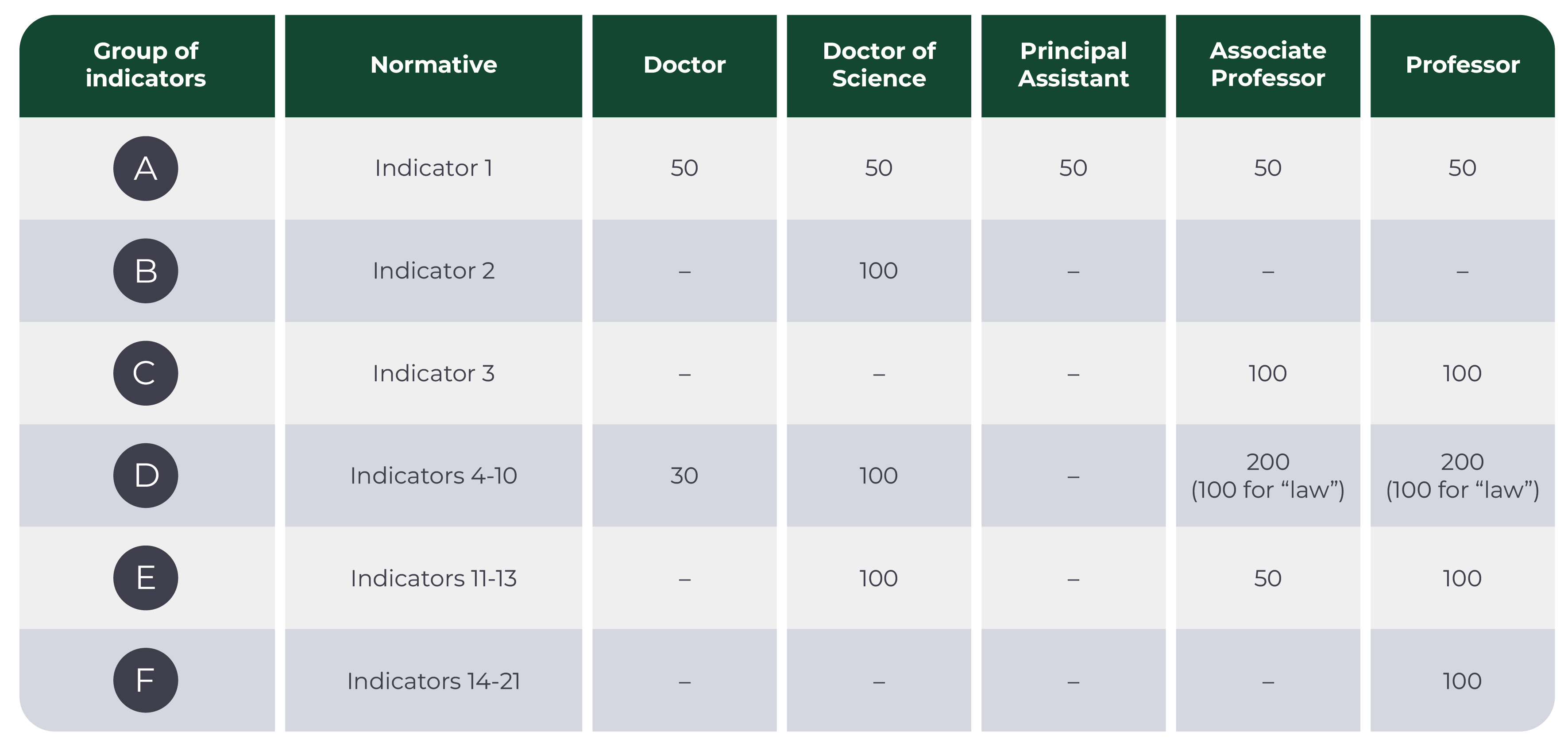
The table below shows the minimum points that a candidate must achieve to successfully obtain a scientific degree or academic title.
Minimum number of points required for academic degrees and scientific titles in social, economic and legal sciences
Number of points by indicators:
|
Group of indicators |
Indicator |
Number of points |
|
А |
1. Defence of a thesis for the scientific degree "Doctor". |
50 |
|
B |
2. Defence of a thesis for the scientific degree "Doctor of Science". |
100 |
|
C |
3. Monograph on the dissertation for the scientific doctoral degree. |
100 |
|
D |
4. Publication of a monograph not submitted as a major thesis. |
100 |
|
5. Publication of a book based on a defended dissertation for the scientific degree of "doctor" or "doctor of sciences". |
75 |
|
|
6. Scientific publications in journals reviewed in the international databases Scopus or Web of Science (*n - number of co-authors). |
30/n |
|
|
7. Scientific publications in non-peer-reviewed scientific journals or collective collections (*n - number of co-authors). |
10/n |
|
|
8. Studies published and cited in scientific journals indexed in Scopus or Web of Science (*n - number of co-authors). |
45/n |
|
|
9. Studies published in non-peer-reviewed scientific journals or collective collections (*n - number of co-authors). |
15/n |
|
|
10. Published chapter in a collective monograph (*n - number of co-authors). |
20/n |
|
|
E
|
11. Citation in scientific publications that are indexed in international databases Scopus/Web of Science or in monographs and collective collections. |
15 |
|
12. Citation in monographs and peer-reviewed collective collections. |
10 |
|
|
13. Citation in non-peer-reviewed scientific journals. |
5 |
|
|
F
|
14. Obtaining the scientific degree "Doctor of Science". |
40 |
|
15. Scientific supervision of a successfully defended doctoral student (*n - number of co-supervisor of the corresponding doctoral student). |
40/n |
|
|
16. Participation in a national scientific or educational project. |
15 |
|
|
17. Participation in an international scientific or educational project. |
20 |
|
|
18. Leading a national research or education project. |
30 |
|
|
19. Management of an international scientific or educational project. |
40 |
|
|
20. Published university or school textbook (*n - number of co-authors). |
40/n |
|
|
21. Published university textbook or school textbook (*n - number of co-authors). |
20/n |
|
Entrust the publication of scientific articles to professionals!
Scientific Publications has been helping researchers to successfully place papers in Scopus and Web of Science since 2016, ensuring their guaranteed indexing in leading international databases. Submit your application today and get a free consultation from our expert!