Almost every author tries to find an effective way to increase their Hirsch index, as a high indicator reflects the author’s influence within the academic community. Success in this largely depends on a properly developed publication strategy, an important part of which is writing review articles. What are these types of publications, and how do they help increase the h-index? Let us explore this in more detail below.
What is a review article?
A review article – is a type of scientific publication in which the author does not present new empirical results but instead carries out a synthesis and analysis of existing research on a given topic. Its main purpose is to systematise accumulated knowledge, identify trends, research gaps, contradictions, and prospects for the development of the discipline.
Unlike original research articles, review articles focus on summarising the literature. They are especially valuable for early-career researchers, students, and specialists entering a new field, as they help to better understand the current state of the discipline.
Types of review articles
It should be noted that, depending on the methodology and purpose set by the author, review articles are divided into several main types. This allows almost every researcher to choose the most relevant format.
| Type of review | Description |
|---|---|
| Narrative review | A traditional review in which the author selects sources based on personal judgement without a strict methodology. |
| Systematic review | A review conducted according to a clear protocol. It ensures high reproducibility of results for other researchers. |
| Meta-analysis | A quantitative synthesis of data from several studies. In this case, the author takes data from many studies and statistically generalises them into a single result. |
| Scoping review | A preliminary broad review that shows what has already been studied in the field, what approaches exist, topics covered, and knowledge gaps. It does not necessarily assess the quality of studies but only defines scope and gaps. |
| Rapid review | A simplified version of a systematic review. It is used when the author has limited time to prepare the publication. |
| Umbrella review | A synthesis of already published systematic reviews and meta-analyses. |
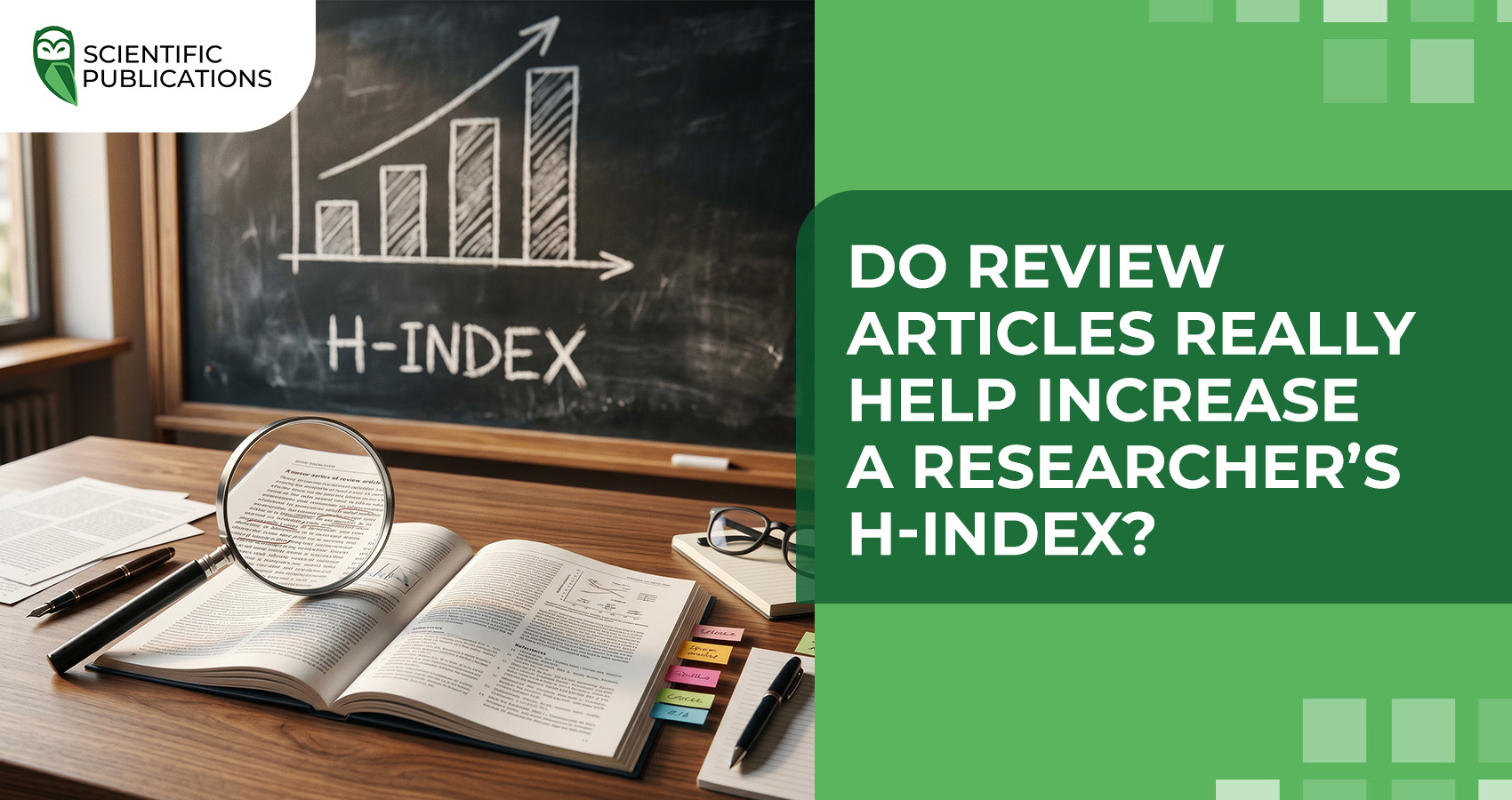
How do review articles help increase a researcher’s h-index?
It should be noted that the Hirsch index takes into account the number of publications and the number of citations. Accordingly, the more frequently an author publishes and the more actively their articles are cited by other researchers, the higher the indicator becomes. Review articles are one of the most effective tools that contribute to the growth of the h-index. How does this mechanism work?
High citation rate
Review articles systematise a large body of literature, therefore they are actively used as a source of data when writing literature reviews in original research articles. Since researchers aim to optimise their time as much as possible, it is much more convenient for them to refer to an already synthesised source.
As a result, a high-quality review article can accumulate dozens or even hundreds of citations per year, especially if it is published in a high-ranking journal.
Increased researcher visibility
Publishing a review positions the author as an expert in the field. This increases the likelihood of conference invitations, collaborations, and further citations not only of the review itself but also of the author’s other works.
Long-term impact
Unlike many original articles that may become outdated quickly, high-quality review articles remain relevant for longer periods (especially systematic reviews and meta-analyses), continuing to accumulate citations over many years.
Effect of “cross-citation” of one’s own works
A review article gives the author the opportunity to appropriately include references to their previous original studies if they are relevant to the topic of the review. When the review is actively cited by other researchers, some of them also consult the original sources and cite the author’s primary works. Thus, not only one publication but the entire author profile gains increased citation impact.
Review articles are indeed one of the most effective ways to increase the h-index for most researchers. However, it is important to remember that not every such work will automatically boost citation metrics dramatically. It is crucial to systematically work on promoting one’s publications while also developing original research articles, as they demonstrate the researcher’s level of expertise.
If you are experiencing difficulties in increasing your Hirsch index and require professional support, contact the Scientific Publications company. Our specialists will conduct an audit of your profiles in scientometric databases and help you develop an individual strategy to improve your indicator. Would you like to receive a free consultation? Leave your contact details in the form below, and our manager will answer all your questions. Together towards new scientific achievements!